
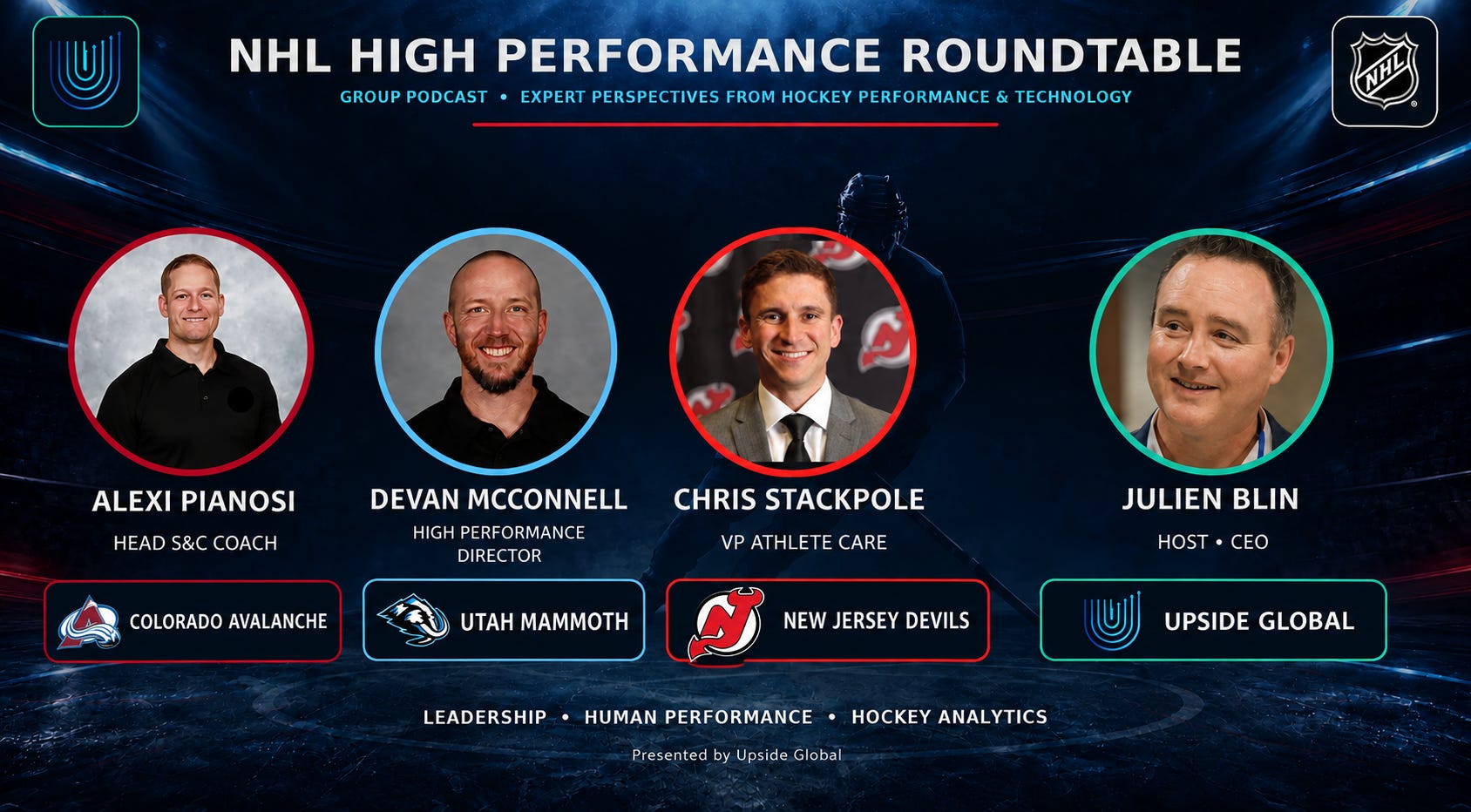
This week we have the honor to interview a group of NHL sports performance executives to talk about the new NHL’s CBA agreement, the shorter preseason, the new neck protection mandate and shorter contracts.
Alexi Pianosi, Head S&C coach, Colorado avalanche (NHL).
Devan McConnell, High performance director, Utah Mammoth (NHL).
Chris Stackpole, VP of Athlete Care, NJ Devils (NHL)
📝Show Notes: Through this interview, we touched on the following topics:
LTIR (Long-Term Injured Reserve) reform and return-to-play pressure
Two more games, four fewer preseason contests
New CBA Agreement: The ban on old-school fitness testing
Neck protection mandate and equipment-driven injury prevention
Shorter contracts and continuity of care
You can watch the video interview below by clicking on the Youtube link. You can also listen to the audio interview by clicking on the link at the top of the page:
You can read the full transcript of the podcast interview located at the top of this blog post.
Here are some of the best quotes of our conversation with Alexi, Chris, and Devan.
1. LTIR reform and return-to-play pressure
Discussion: Does limiting LTIR salary-cap relief reduce pressure on medical and performance practitioners, or simply move that pressure elsewhere?
Chris Stackpole — New Jersey Devils
“From our operational perspective, I don’t think as a staff it makes any difference. I think all the guys on the call would probably agree, we’re trying to get players back as quick as possible and as healthy as possible, and the rest is up to the GMs for how they manage the roster.”
Devan McConnell — Utah Mammoth
“Our job hasn’t changed as far as our role in trying to get athletes back on the ice as fast as possible and as safely as possible. Those decisions around roster management happen kind of above our level.”
Devan McConnell — Utah Mammoth
“We get them ready to be active, and then we kind of hand them off to make the decisions above us. From our perspective, it really hasn’t changed much.”
✅ Four recommendations for NHL teams
Maintain clear boundaries between return-to-play readiness and roster management. Medical and performance staff should assess health and readiness independently of salary-cap considerations.
Preserve a consistent rehabilitation process. Base return-to-play progression on the player’s recovery and ability to perform safely rather than contractual or roster pressures.
Clarify responsibilities across departments. Establish clear communication between medical staff, performance staff, coaches and general managers, with defined decision-making authority.
Document readiness decisions consistently. Maintain transparent injury assessments, rehabilitation milestones and clearance decisions so the medical rationale remains clear.
2. Two additional regular-season games and a shorter preseason
Discussion: How should teams prepare players for an 84-game season with fewer preseason games and fewer opportunities for conditioning and evaluation?
Devan McConnell — Utah Mammoth
“It’s gonna be different based on how your team is structured, and where your team is at as far as are you a young team that’s developing and needs more practice time and more growth time, or are you a more veteran team that’s further along the development pathway?”
Alexi Pianosi — Colorado Avalanche
“Basically practice, practice, play, day off. Practice, practice, play, day off. And then start the season. From my standpoint, our group is a little bit older. They’ve been together for a while. Our core is kind of intact, so the culture and the work ethic’s already established.”
Alexi Pianosi — Colorado Avalanche
“Maybe just put a little more emphasis on the time before training camp starts, in that one to three weeks when players come in a little bit early and start to do captain skates and informal workouts and things like that.”
Chris Stackpole — New Jersey Devils
“A couple more practices, even two or three more practices, could’ve been useful. But beyond that, it was nice not having to test as many things. Most of our roster was fairly established, so it was much easier this year to progress through everything.”
✅ Four recommendations for NHL teams
Customize preseason preparation to roster composition. Younger or rebuilding teams may require more structured development and evaluation than veteran teams with established systems.
Educating players on the importance of an appropriate ramp up prior to camp starting considering the condensed time schedule.
Optimize practice-to-recovery scheduling. Make deliberate use of the limited available practice days, game exposures and mandated rest days.
Protect opportunities to evaluate younger players. With fewer games and practices, establish clear evaluation priorities so prospects are not judged disproportionately on one poor performance.
3. Restrictions on traditional fitness testing
Discussion: How do restrictions on certain preseason fitness assessments affect performance monitoring, baseline data collection and return-to-play decisions?
Devan McConnell — Utah Mammoth
“The area that I think is lacking is really the baseline assessment that can come into play in a return-to-play scenario. Unfortunately, we don’t have that type of information if a player does get injured down the road and we can’t look back and see where they were when they were at their fittest, at their freshest.”
Devan McConnell — Utah Mammoth
“None of us are doing any assessments, any force plates, any strength testing, any VO2 testing, any of that stuff. I don’t think anybody in the league touched anything this year because of the potential repercussions.”
Alexi Pianosi — Colorado Avalanche
“Where you might have just done a drill that was on the force plates, you just do the same drill off the force plates. If you’re picking the right exercises and things like that, then they’re hopefully getting that adaptive stimulus that you want and getting the benefits of it.”
Chris Stackpole — New Jersey Devils
“It’s helped our medical staff and the communication between medical, strength coaches and skill coaches improve in what we’re doing because we can’t just rely on testing to say, ‘Oh, this guy’s weaker. This guy’s got a deficit.’”
✅ Four recommendations for NHL teams
Establish clear CBA-compliant testing policies. Ensure practitioners understand which assessments, data collection activities and storage practices are permitted, including any distinctions for injured players.
Strengthen collaboration between medical, performance and skill coaches. Use coordinated observations of movement, pain, dysfunction, practice demands and athlete response rather than relying exclusively on test scores.
Preserve training quality without prohibited assessments. Continue appropriate strength, mobility and conditioning exercises while adapting workflows to the restrictions.
Address the return-to-play baseline challenge. Work with medical leadership and league compliance personnel to establish permitted ways to assess injured athletes and support safe rehabilitation decisions.
4. Neck protection mandates and equipment-driven injury prevention
Discussion: How are teams encouraging protective-equipment adoption, improving player comfort and promoting a stronger safety culture?
Devan McConnell — Utah Mammoth
“Our equipment managers do a great job of really trying to strongly suggest guys wear at least the cut-proof wrist protection and socks and things like that, and have that stuff widely available and let guys try that stuff out and get as comfortable as possible with it.”
Devan McConnell — Utah Mammoth
“As younger players come into the league, it’s the same thing that the league went through with visors 10 or 15 years ago and probably 20 to 30 years ago with helmets. As these things get grandfathered in, it’ll become commonplace.”
Alexi Pianosi — Colorado Avalanche
“You do everything you can to keep the players safe. But to be honest, I would consider that more of an equipment manager’s responsibility or interaction with them, and management on what they want players to wear.”
Chris Stackpole — New Jersey Devils
“We’re working with the equipment staff to make sure everyone’s aware. They show enough videos to get guys to realize how many near calls or near misses there are. We’re constantly trying to push the best, most protective things. It’ll just take time before everyone buys in.”
✅ Four recommendations for NHL teams
Make protective equipment readily available. Offer appropriate neck guards, cut-resistant socks and wrist protection, with opportunities for players to try different options.
Prioritize fit, comfort and player feedback. Work with equipment managers and athletes to identify protective products that minimize discomfort and interference with performance.
Educate players about preventable injuries. Use relevant injury examples, near-miss footage and clear explanations to increase awareness and encourage adoption.
Integrate equipment safety into player onboarding. Ensure new players understand the applicable requirements and that veteran players receive consistent encouragement to use appropriate protection.
5. Shorter contracts and continuity of care
Discussion: Will shorter maximum contracts and potential player movement disrupt injury management, rehabilitation relationships and long-term performance support?
Devan McConnell — Utah Mammoth
“You try to create a relationship with guys as they come in and build trust and build rapport, and you do that as quickly as possible. When guys are there a little bit longer, obviously you have more time to build that.”
Alexi Pianosi — Colorado Avalanche
“You want everybody to be performing at their best, and you treat everybody like they’re gonna be there for the next eight years. But you also know that they could get traded tomorrow.”
Chris Stackpole — New Jersey Devils
“I think the continuity of the GMs and the coaches and the medical performance staff is even more impactful so that you have a stable base to work from, because the players will continue kind of revolving.”
Chris Stackpole — New Jersey Devils
“If guys that have worked with you in the past have respected what the team has done, they’re more likely to come in and have a positive experience.”
Alexi Pianosi — Colorado Avalanche
“When new management or coaches come in, they might have the new structure or style of doing things or even just one small thing they wanna do differently, and it’s on the staff to adapt.”
✅ Four recommendations for NHL teams
Build trust immediately with incoming players. Use onboarding conversations to understand individual training preferences, injury concerns, rehabilitation experiences and performance goals.
Maintain continuity within medical and performance departments. Recognize the value of experienced staff who preserve organizational knowledge and established relationships.
Prepare for frequent roster changes. Develop consistent onboarding and transition processes so new players can integrate quickly, with appropriate access to authorized medical and performance information.
Adapt workflows to new coaching philosophies without losing continuity of care. Be flexible about reporting, planning and communication while maintaining consistent standards of player support.
You may also like:
🏒 Upside NHL Group Chat with Alexi Pianosi (Colorado), Kevin Morley (Nashville Predators), Adam Douglas (Sportlogiq), Devan McConnell (Utah Mammoth) on NHL Offseason Preparation, Tech Audits & More

This week we have the honor to interview a group of NHL sports performance executives to talk about the latest trends in the world of sports performance.

🔥Upside NHL Group Chat with Alexi Pianosi (Colorado Avalanche), Chris Stackpole (NJ Devils), Adam Douglas (Penguins)

This week we have the honor to interview a group of NHL sports performance executives to talk about the latest trends in the world of sports performance, load management, sleep/recovery management, rehabilitation and data & wearable tech integration, and mental performance in the NHL.