
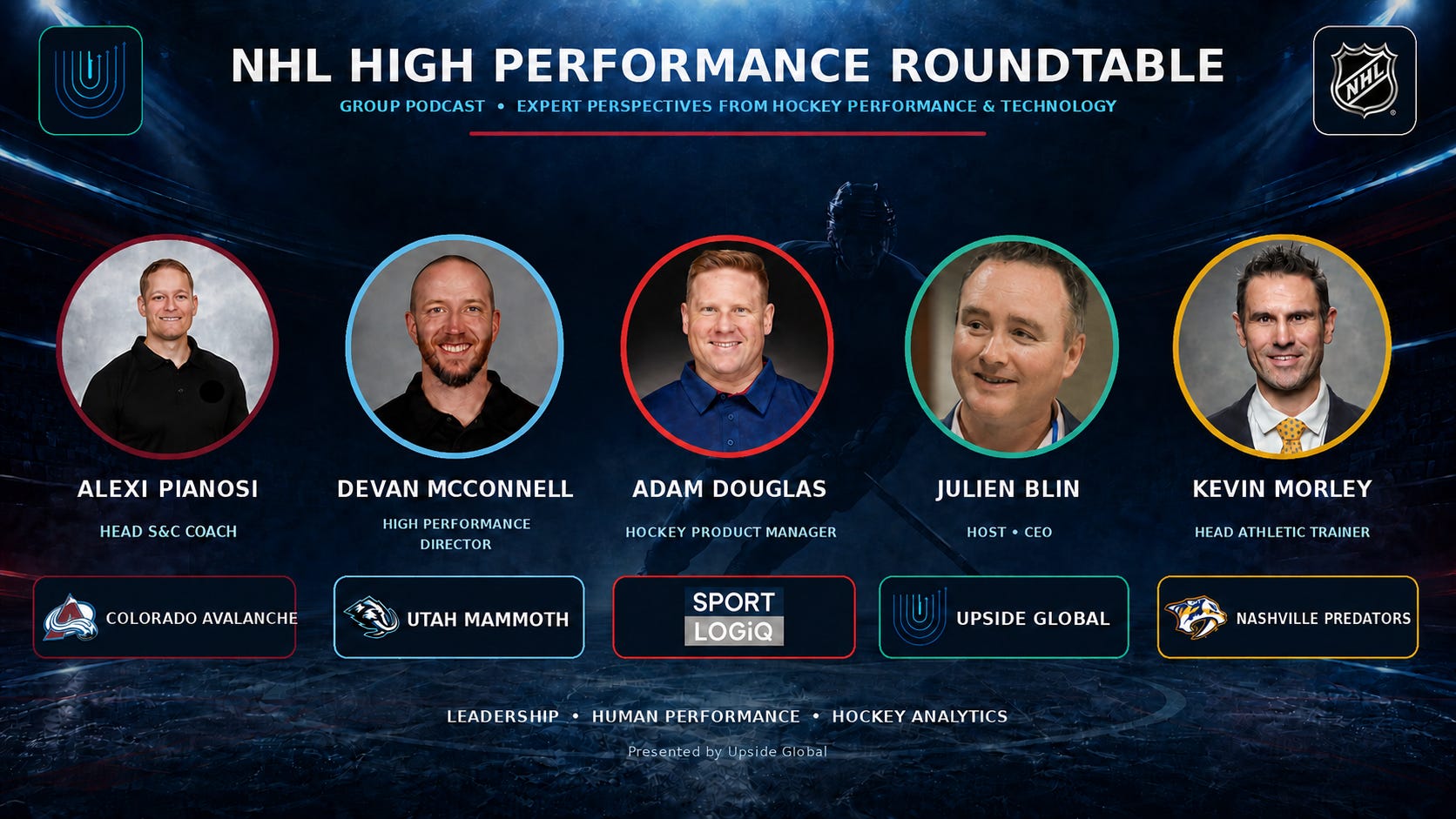
This week we have the honor to interview a group of NHL sports performance executives to talk about the latest trends in the world of sports performance.
Alexi Pianosi, Head S&C coach, Colorado avalanche (NHL Team).
Adam Douglas, Hockey Product Manager, Sportslogiq. Adam is also the former S&C coach for the Pittsburgh Penguins (NHL Team).
Kevin Morley, Head ATC, Nashville Predator (NHL team).
Devan McConnell, High performance director, Utah Mammoth (NHL Team).
📝Show Notes: Through this interview, we touched on the best practices related to:
Preparing players for NHL training camps
Managing a shorter preseason and longer regular NHL season
Reassessing the technology stack
Defining a successful start to the season
Aligning team staff with players’ private performance teams
You can watch the video interview below by clicking on the Youtube link. You can also listen to the audio interview by clicking on the link at the top of the page:
You can read the full transcript of the podcast interview located at the top of this blog post.
Here are some of the best quotes of our conversation with Alexi, Kevin, Devan and Adam:
1. Preparing players for NHL training camps
Devan McConnell
“The number-one priority is clearing up any medical issues. We want players coming back healthy, back to baseline—or improved physically from where they were the previous season—so they’re ready to perform.”
“With an older veteran, the developmental window might be closed and you’re getting them back to who they are as a mature player. A 19-, 20-, or 22-year-old is still physically developing, so you’re trying to move the needle.”
Alexi Pianosi
“Training camp tends to bring a spike in intensity and skating volume. The closer we can bridge the gap between offseason skating and training-camp skating—in speed, intensity, and volume—the better prepared players will be to stay healthy.”
“The work is finding the players who might arrive with issues and getting ahead of those problems—finding solutions before they become problems.”
Adam Douglas
“Guys train. Guys prepare. Guys skate. If a player doesn’t have a great training environment at home, teams can create a place where they want to train and develop.”
✅ Key Recommendations for Teams: Preparing players for training camps
Resolve medical issues and return players to a healthy baseline.
Prepare players for camp-level skating speed, volume, and intensity.
Emphasize maintenance for veterans and development for younger players.
Create individualized plans for injured players and new acquisitions.
2. Managing a shorter NHL preseason and longer regular season
Devan McConnell
“We’re being squeezed at both ends: we have less time to manage workloads and get players up to speed, while losing some of the tools that have been beneficial over the last 10 to 15 years.”
“It may have to go back to the coaching eye—communicating, having good discussions with the staff, and making informed decisions without relying on the data quite as much.”
Alexi Pianosi
“A shorter camp puts more responsibility on the staff to prepare ahead of training camp so you can expedite those early growing pains.”
“You’re going to have to screen players early, get ahead of potential issues, and nip those problems in the bud before they happen.”
Adam Douglas
“It will be interesting to see whether veteran players arrive earlier than usual so they can get high-quality skates in and get their legs underneath them before camp.”
✅ Key Recommendations for Teams: Managing a shorter preseason and longer regular season
Begin high-quality skating and conditioning before camp.
Screen players early and monitor workload and fatigue.
Use rest days strategically to reduce injury risk.
Adjust preparation according to roster age, experience, and turnover.
3. Reassessing the technology stack
Devan McConnell
“It’s an ongoing process. You’re always evaluating what tools you have, what questions you need answered, and whether those tools are helping you answer those questions.”
“I’m always curious and eager to learn, but something doesn’t need to be added to our process simply because another team is using it.”
Alexi Pianosi
“Exploring new technology has to start with where your team came up short last year. What did you not do well, and what do you need to do better?”
“After the season, look at what you used and what you didn’t use. If you didn’t use something all season, there probably isn’t a good case for continuing to pay for it.”
“The best beta test is whether players like something for one or two days—or whether they’re still using it after a month.”
Adam Douglas
“The best recovery modalities are the ones where you can create stickiness across multiple players, multiple departments, and multiple points in the schedule.”
“In the recovery space, your BS meter and your Spidey senses need to be on high alert, because there’s a lot of voodoo out there.”
✅ Key Recommendations for Teams: Reassessing the technology stack
Retain technology that answers important performance or medical questions.
Remove tools that are underused or do not influence decisions.
Pilot new products and evaluate long-term player adoption.
Consider evidence, cost, contracts, space, and workflow.
4. Defining a successful start to the NHL season
Alexi Pianosi
“You can define success in a variety of ways. Before the season starts, you have to decide: What are our KPIs? What do we really want to improve?”
“Ultimately, you want to be playing really well in April, May, and June—not necessarily in October and November. The beginning of the season is part of that process.”
Devan McConnell
“Success is completely context-dependent. During a rebuild, it may be about establishing a training culture and team culture. With an established team, wins and losses may become part of the expectation.”
“From a performance standpoint, it would be very unsuccessful if we had a lot of players on the training table. I’d feel that we hadn’t done our job if players were already banged up coming through camp.”
✅ Key Recommendations for Teams: Defining a successful start to the season
Establish team-specific performance and health KPIs.
Monitor injuries, recovery, energy, and workout participation.
Evaluate team cohesion, practice quality, and tactical progress.
Adjust when injuries, fatigue, or performance problems begin increasing.
5. Aligning team staff with players’ private performance teams
Alexi Pianosi
“Create an environment for an open exchange so that whatever the private trainer did can flow back into what you do. You might have chosen a different drill, but you can still appreciate the thought process and recognize that you’re pursuing the same adaptation.”
“Players can feel when there isn’t a competition or push-and-pull between practitioners. It isn’t about who is right or wrong—it’s about everyone being there to help the player.”
Devan McConnell
“It comes down to relationships and communicating with the offseason professionals: explaining our organizational KPIs, the player’s individual KPIs, what we see, what they see, and our training philosophy.”
“We’re flexible, and we work with players—not over players. Especially with veteran players, we see them as colleagues. We work together to reach conclusions and provide the best support possible.”
Kevin Morley
“I’ve learned enough in my career to know that I don’t know all that much—and that there are a lot of right ways to do things. The scaffolding can be different while the goal remains the same.”
“We tell our players, ‘You’re your own LLC.’ Their body is how they provide for their family, so we approach it as a partnership.”
“Let us work together to find what works best for you, and then we’ll add and take things away as we go.”
Adam Douglas
“The person an athlete chooses to work with in the offseason is someone it’s in my best interest to know. Share the scaffolding, share the philosophy, and work together.”
“I want that practitioner to understand what we’re trying to accomplish from a team perspective and become a champion in the player’s ear.”
✅ Key Recommendations for Teams: Aligning team staff with players’ private performance teams
Treat private coaches and medical professionals as partners.
Share team goals, player KPIs, and relevant health information.
Understand the reasoning behind each player’s offseason program.
Preserve effective work and build the in-season plan collaboratively.
You may also like:
🔥Upside NHL Group Chat with Alexi Pianosi (Colorado), Chris Stackpole (NJ Devils), Adam Douglas (Sportlogiq), Devan McConnell (Utah Mammoth) on Humans’ Intuition, RTP, Key Metrics & NHL Profiles

This week we have the honor to interview a group of NHL sports performance executives to talk about the latest trends in the world of sports performance.
🔥Upside NHL Group Chat with Alexi Pianosi (Colorado Avalanche), Chris Stackpole (NJ Devils), Adam Douglas (Penguins)

This week we have the honor to interview a group of NHL sports performance executives to talk about the latest trends in the world of sports performance, load management, sleep/recovery management, rehabilitation and data & wearable tech integration, and mental performance in the NHL.
🔥Upside NBA Video Chat with Dr Marco Nunez (Ex LA Lakers/NBA), Derek Millender (Cavs/NBA), Ryan Petersen (Chicago Bulls / NBA) on The Life after the NBA, Technology Adoption, Performance Optimization

This week we have the honor to interview again a group of NBA sports performance executives to talk about the latest trends in the world of sports performance and rehabilitation.
🔥Upside NCAA Group Chat with Paul Silvestri (Florida Gators), Drew Lukes (Duke University), Dr John DeWitt (Rice University), Elva Salcido (UNLV), On Heat, Practice, Nutrition, Recovery

Today we have the honor of interviewing a group of NCAA sports performance experts.


