

Today we have the honor of interviewing Gavin Benjafield, performance director at LAFC, an MLS team.

Gavin Benjafield is the Performance Director at Los Angeles Football Club (LAFC), where he leads an integrated performance department spanning strength and conditioning, sports science, nutrition, data, and mental performance. Originally from South Africa, he has over 20 years of experience in elite football, beginning his career at Ajax Cape Town before progressing to Ajax Amsterdam in the Netherlands and later working in the Premier League. He holds a background and degree in exercise physiology, with expertise in final-phase rehabilitation and sports science, having developed his career during a time when practitioners were more generalist before the field became highly specialized. In 2018, he joined LAFC at its inception, drawn by the rare opportunity to build a high-performance model from the ground up, and has since played a key role in shaping the club’s performance philosophy and interdisciplinary approach.
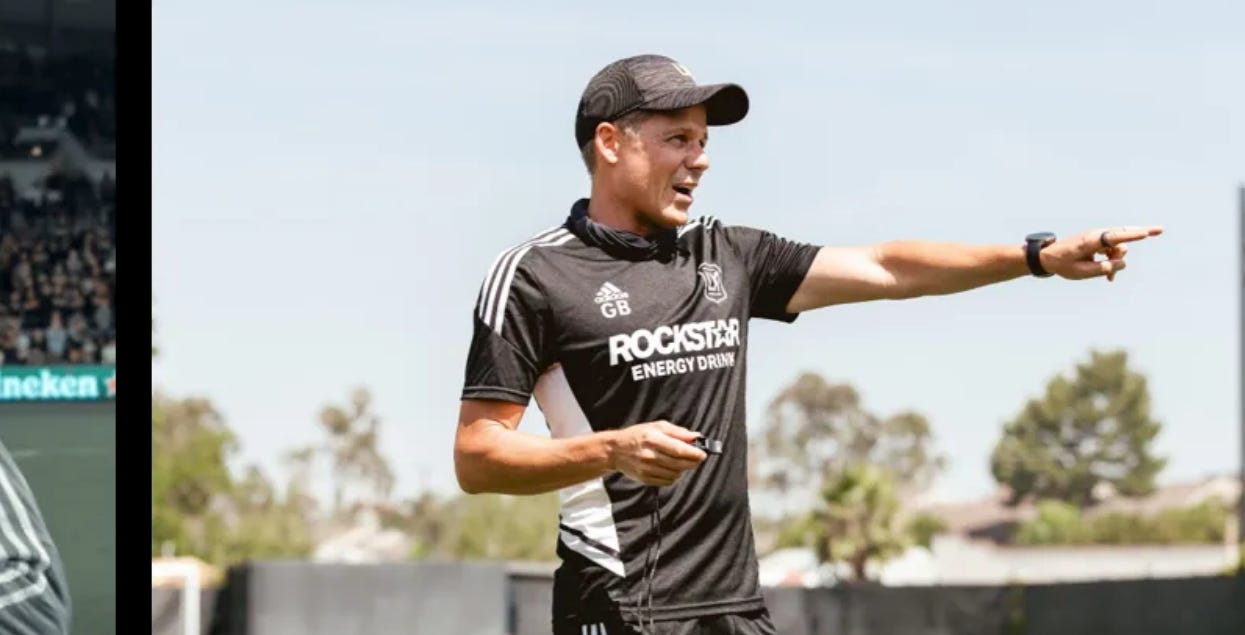
You can watch the video interview below by clicking on the Youtube link. You can also listen to the audio interview by clicking on the link at the top of the page:
📝Show Notes: Through this interview, we touched on:
His background and what led him to LAFC.
His role at LAFC, and what a typical day looks like.
His approach towards performance training, S&C, rehab and innovation.
How he sees the world of performance training in elite sports evolving in the coming years.
Which technologies he would build if he had unlimited resources.
You can read the full transcript of the podcast interview with Gavin located at the top of this blog post.
Here are the quotes from the interview with Gavin:
Q1. Background & path to LAFC
“I’ve been involved in football for close on 20 years. I’m South African, I started with Ajax Cape Town, then moved to the Netherlands with Ajax Amsterdam, and later worked in the Premier League before landing in Los Angeles in 2018. My background is exercise physiology, final phase rehabilitation, sports science—at that time we were still pretty generalists, and the industry has since become much more specialized. The big attraction for me coming to LAFC was that I’d never been in a club where I had the opportunity to build something from the ground up. In 2017 the club didn’t really exist at first-team level, so it was like having a piece of land and saying, ‘this is how we’re going to build the house.’ That opportunity was unique, and I felt this may be the only time in my career where I could do something like that.”
Q2. Role at LAFC & typical day
“My role as Performance Director is primarily overseeing areas like strength and conditioning, sports science, data science, nutrition, and mental performance coaching. It’s very much a managerial role—I’m the connector between all those disciplines, the players, the coaching staff, and the leadership. I’ve stepped away from being a specialist; instead, I hire experts in each field and make sure everything is aligned. There isn’t really a ‘normal’ day, but we do fall into a rhythm. We start early—around 7:45 the medical and performance teams meet to align on the day, then smaller staff meetings follow, and by 9:00 we meet with coaches. From nine to ten is really important for player interaction, maintaining those relationships. Training starts mid-morning, and the rest of the day flows from there. The challenge is that it becomes very cyclical, so you have to deliberately create moments to reflect, sit down with staff, and think about how to improve—because that’s really where the gold is found.”
Q3. Approach to performance, S&C, rehab & innovation
“For me, performance is a singular unit—everyone’s role is ultimately pointed toward improving team performance. Whether you’re in nutrition, strength and conditioning, or data, the question is always: how are you enhancing the player and the team? We are one team with different specializations. I often use analogies like Formula One, where even one person’s role is critical—if they don’t execute, the whole system is impacted. Or like an orchestra, where everyone plays a different instrument but must be aligned. I really emphasize teamwork, collaboration, and communication. My philosophy is not rigid—it’s fluid, because every season presents a different challenge. Whether it’s schedule congestion, injuries, or travel, you need a unique approach each time. Ultimately, our goal is to maximize player potential, maximize availability, and navigate the season as effectively as possible.”
Q4. Future of performance training
“I think we now have so much information at our fingertips that we’re actually becoming distracted. It’s very easy to keep adding new tools, new technologies, new ideas, thinking they will enhance performance—but often we’re just diluting what was already working. If we look back five years, we have to ask whether all these additions have really produced better outcomes. Distraction is becoming one of our biggest enemies. We can’t create more time with athletes, so if we keep adding more tasks, we’re just overloading both staff and players. I use the analogy of a backpack—if we keep adding more, we just end up tiring ourselves out. I believe the future is about simplification and consistency. If we reduce the number of ‘new’ inputs, we can apply things more consistently, and that’s what actually allows athletes to adapt and improve over time.”
Q5. Dream technology
“If I had unlimited resources, I would build a single, discreet device that captures everything—something like a continuous monitoring system that combines all the functions we currently separate across multiple tools. I want to see how an athlete moves from fatigue back to readiness, how travel impacts them, how they respond to both physical and mental stress over time. Right now, a lot of what we do is still a best guess, especially early in the training week. Ideally, we’d have continuous physiological data that helps us make better decisions day by day. The key is that it has to be simple—players don’t want to wear more technology, they want to wear less. At the moment, we risk turning athletes into robots by asking them to wear multiple devices. The goal should be one solution that gives us richer insights while staying completely in the background and allowing athletes to perform naturally.”
You may also like:

🎙️ Upside Video Chat with Dhia Amara, Lead S&C coach, CF Montreal (MLS)

Today we have the honor of interviewing Dhia Amara, the lead S&C coach of CF Montreal, an MLS team.


