
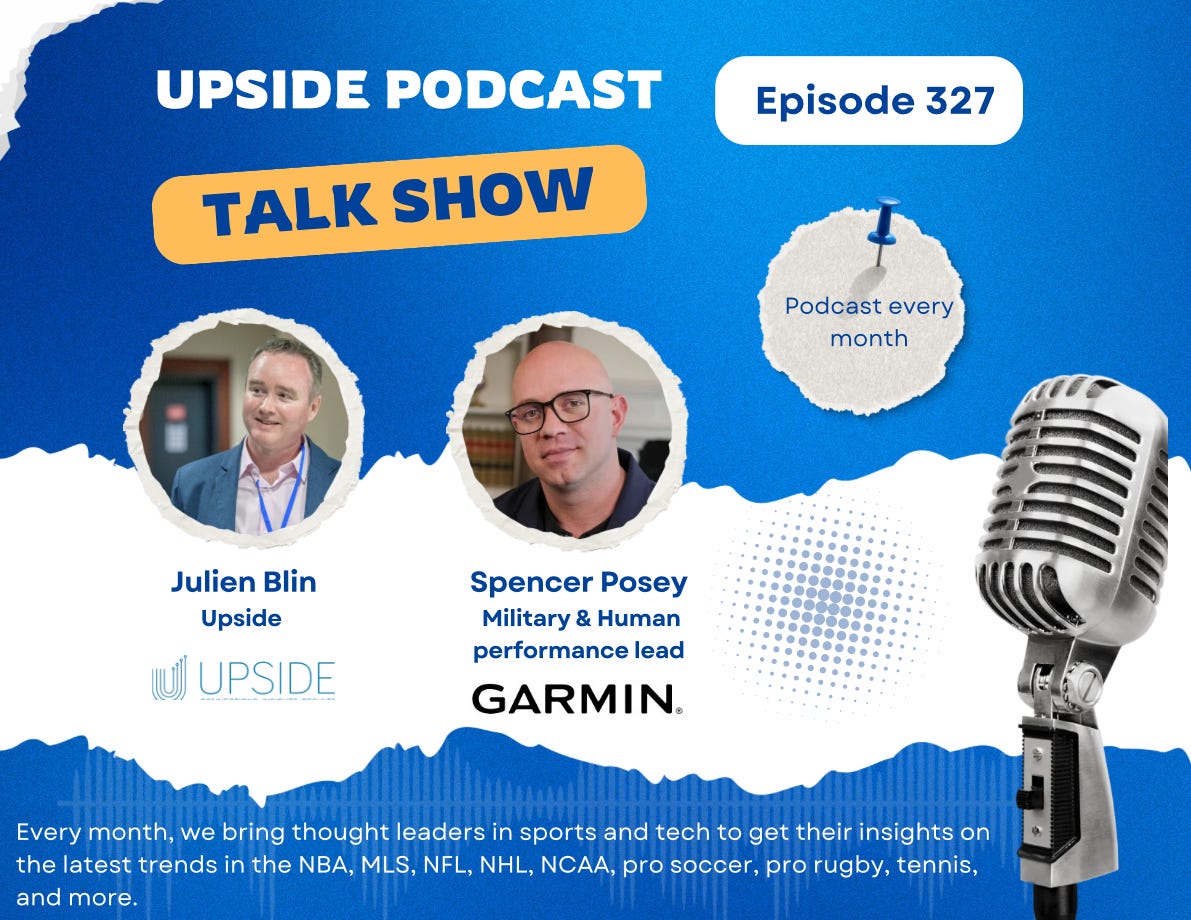
Today we have the honor to interview Spencer Posey, the Military & Human Performance Lead for Garmin. Spencer will also be speaking at the Austin Peay State University Health and Performance Summit on October 17, 2026.
You can check out the agenda of the Austin Peay State University Health and Performance Summit, get your ticket for the summit by clicking on the link below and select register now:
For sponsorship information, attendees can visit the event website or contact Dr. Tim Leszczak, Chair of the APSU Health and Human Performance Department, at Leszczakt@apsu.edu.
You can watch the video interview below or you can listen to the audio interview above:
You can read the full transcript of the podcast interview located at the top of this blog post.
Here are some of the best quotes of our conversation with Spencer:
Q1. Background & Career Journey
“I clawed myself out of that hole through these principles of taking care of oneself in a holistic manner. I put effort into what I put into my body, into my mind, how I trained myself, how I slept — and that investment in those areas helped me claw out of that space.”
“As I read that historical document — Field Manual 7-22 — I realized that the program the US Army was trying to implement, essentially I had done in my own private practice in industry and academics for the better part of a decade.”
“The mission and vision of Garmin is they exist to help people beat yesterday. And that simple sentence aligns with my entire life’s work. Hands down.”
“When I came back in at the US Army, my sole goal was to give. Give whatever I could to the institution.”
Q2. Role at Garmin Health
“My role is part relationship building, part strategic vision and direction for the organization, and part translating science into real world application for different opportunities.”
“Across a week, I can work with military organizations, researchers, tactical professionals, strength and conditioning coaches, and also healthcare providers to help them understand what problems they’re actually trying to solve, what questions they’re trying to answer, and what interventions they can make based off those data points.”
Q3. Training, Recovery & Rehabilitation
“I see the biggest change in the space going from reactive decision-making to proactive.”
“The best organizations are finding which metrics — and I’m gonna say just a couple, not all of them — they zoom in on a couple metrics that they find have the strongest correlation or causation to their genre of people or population, and they focus on those.”
“Context matters. When organizations start to understand that all this data matters, but then having the individual of whose data you’re taking provide the context of what goes on the 23 hours outside of training — that’s where the magic happens.”
“With heart rate variability, there’s a lot of folks that haven’t dove into what that means over time, and they’re looking at it in a very acute sense. In reality, you need to look at the trend and then also the variation over time as the two most important variables.”
Q4. Innovation & Future Trends
“In the next three to five years I see a ton happening around individualized and contextualized decision support — the use of AI, or language models, to provide that contextualized specific intervention for the individual.”
“I think we already have more data than we need. It’s about creating a better interpretation or educating folks on how to interpret that data. Right now with the amount that we have, I would say it’s a lot of noise. So how do we create a strong signal versus so much noise with data?”
“I see a merger of many different tools that build a larger ecosystem. Wearables are absolutely an amazing tool, but they’re not the only tool for organizations to be able to implement change.”
“Imagine if you go to your doctor and he pulls up your data and says, ‘Actually, you’re moving 30% less than last year. You’re sleeping 15% less. I would say you’re not doing great.’ That’s being able to zoom out and look at some of those larger things — looking at health in a longitudinal way instead of just snapshots.”
Q5. Health & Performance Summit at Austin Peay State University
“My first goal anytime I speak is to give practical application for everybody that’s there. How to actually apply what they’ve heard is generally the gap.”
“The athlete narrative is what got human performance optimization off the ground within the United States military. But that narrative is not gonna be what’s gonna take us to the next level. It got us off the ground, but it’s not what war fighting is.”
“When you look at what a war fighter is asked to do — in the face of imminent death — it is nowhere close to what an athlete does on a field. Not only is it a higher stress environment, there are different skills required, a different cognitive approach.”
“I’m going to show what from the athlete preparatory approach has worked and will continue to work — and what will now fail us as we’ve gotten the momentum we need with these programs. We no longer need to build leader engagement around it; now we need to fund these programs, operationalize them, and focus actually on the war fighter.”
You may also like:
🎙️ Upside Video Group Chat with Dr. Tim Leszczak and Dr Bill Burgos about the Austin Peay State University Health and Performance Summit

Today we are hosting a new group podcast with Dr. Tim Leszczak and Dr Bill Burgos to discuss Austin Peay State University Health and Performance Summit that you are organizing, which will take place on Saturday, October 17, 2026, at the APSU Health Professions Building in Clarksville, Tennessee.


