
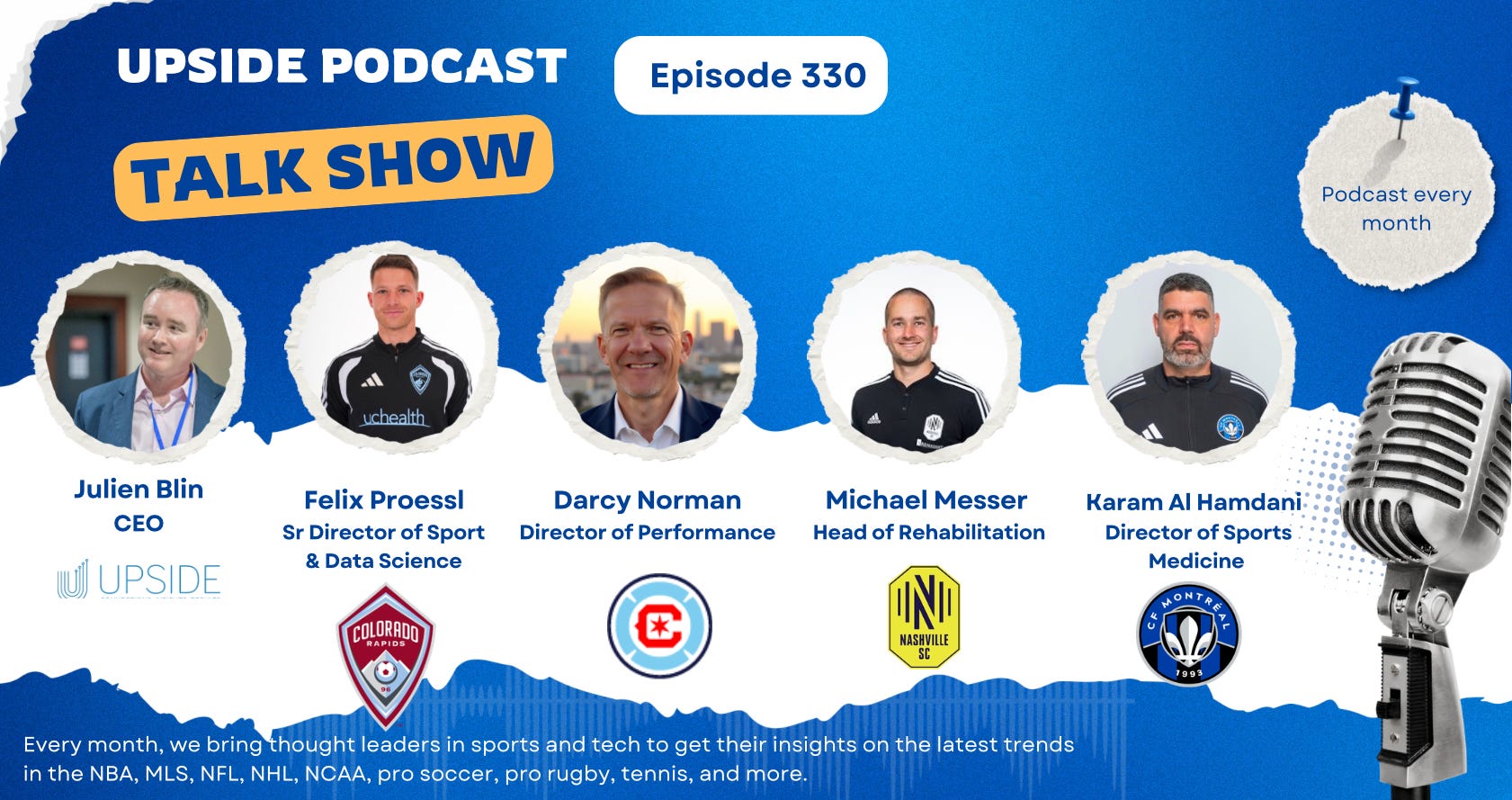
This week we have the honor to interview again a group of sports performance executives to talk about the latest trends in the world of sports performance and rehabilitation.
Darcy Norman, the director of performance, Chicago Fire FC (MLS).
Michael Messer, the head of rehabilitation, Nashville SC (MLS).
Felix Proessl, Sr. Director of Sport and Data Science at the Colorado Rapids (MLS)
Karam Al Hamdani , the director of sports medicine and head athletic therapist at CF Montreal (MLS).
You can watch the video interview below or you can listen to the audio interview above:
📝Show Notes: Through this interview, we touched on:
Heat Adaptation & Cooling Strategies: As matches are increasingly played in hot and humid conditions, what are the most effective heat adaptation and cooling strategies you’ve seen or implemented? Which interventions have the strongest scientific evidence behind them, and which are more hype than reality?
Hydration Breaks in MLS: MLS includes hydration breaks during matches. From a sports science perspective, how much do these breaks actually help with player performance, recovery, and safety? Beyond hydration, do they provide meaningful opportunities for coaches to reset tactics or influence the flow of the game?
Cardiovascular Health in Soccer: Player cardiac health has become an increasingly important topic. How should clubs approach cardiovascular screening and heart rate monitoring throughout the season? With initiatives like MLS’s partnership with Athletic Heart, where do you see the biggest opportunities to improve player safety and performance?
Wearable Technology & GPS Limitations: GPS systems have become standard across professional soccer, but what are their biggest limitations? Where do they fall short when it comes to understanding player workload, fatigue, or readiness?
The Next Generation of Performance Metrics: New technologies—including solutions from companies like ADI—are aiming to provide more objective measures of performance and physiological stress. What gaps do these technologies address, and how do you see them complementing or replacing traditional GPS-based metrics over the next few years?
You can read the full transcript of the podcast interview located at the top of this blog post.
Here are some of the best quotes of our conversation with Darcy, Karam, Felix and Michael:
Q1. Heat Adaptation & Cooling Strategies
Darcy Norman
“It’s really about building up your core temperature and your skin temperature so the body adapts to performing in those conditions. In team sports it’s much more challenging than in individual sports because of all the variables you have to manage. Teams that train in hot, humid environments naturally adapt, while clubs in cooler climates have to be much more intentional about creating those adaptation opportunities.”
“The preparation to play in the heat is all about cooling strategies. You’re trying to get your core temperature as low as possible before kickoff so you delay that heating effect. That could be cooling vests, cold plunges, slushies, cold towels on the neck, or cooling again at halftime. There isn’t one magic solution—it’s about combining several strategies.”
Mike Messer
“Ultimately, what’s most successful is what the player will actually do. We’re seeing much more individualization within the team environment. It’s about finding what a player actually likes—whether it’s a particular electrolyte drink, cooling strategy or recovery method—because the best intervention is the one they’ll consistently adopt.”
Felix Proessl
“There’s a tremendous amount of variability in how much athletes sweat—not just the volume, but the sodium concentration as well. Understanding each athlete’s sweat profile allows you to individualize hydration and electrolyte replacement rather than treating every player the same.”
Karam Al Hamdani
“We’re not reinventing the wheel. We take a strategic approach. Once the temperature reaches a certain threshold, our pre-cooling protocol automatically starts. The nutritionist prepares the slushies, the players know exactly what they’re expected to do, and because we practice it consistently in training, it becomes very easy to implement on match day.”
Karam Al Hamdani (On the use of Pickle Juice)
“There’s really no point taking pickle juice at halftime. You want to take it when you actually feel a cramp coming on. The science suggests it’s the vinegar that creates the sensory response, so timing is important if you’re hoping to get the benefit.”
Q2. Hydration Breaks in MLS
Darcy Norman
“Any time you can take a break from being physically active, it helps recharge your systems. It gives players an opportunity to rehydrate, refuel, recover, and reset mentally and tactically. The flip side is that if your team has momentum, it can interrupt that flow, so it’s something every team has to prepare for.”
Felix Proessl
“We’ve seen momentum shifts after hydration breaks, particularly at the World Cup, where teams have clearly used those moments to make tactical adjustments. From a sports science perspective, we also know that even as little as two percent dehydration reduces performance, so from an athlete’s perspective those breaks are only beneficial.”
Karam Al Hamdani
“Anything above about two percent dehydration starts reducing power output. For a striker who relies on explosive sprinting, that can literally be the difference between getting to the ball first or missing the opportunity entirely. That’s why hydration breaks are so important.”
Mike Messer
“Our coaches definitely appreciate the opportunity to make quick interventions. Maybe it’s not the entire team listening, but if there are two or three players who need a small tactical adjustment, it’s much easier than trying to shout instructions across the field.”
Q3. Cardiovascular Health in Soccer
Karam Al Hamdani
“The MLS has done a phenomenal job with its partnership with Athletic Heart. The league has created a very stringent decision tree that clubs have to follow before a player can be cleared. It starts with an ECG, progresses to echocardiograms if necessary, and if anything remains abnormal, additional testing is required before participation.”
“Early recognition, being prepared and practicing emergency scenarios are just as important as screening. We practice these situations regularly because the more you rehearse them, the easier it becomes if you’re ever faced with a real-life cardiac emergency.”
Darcy Norman
“Everybody would love better monitoring technology because we all want more consistent ways to measure internal load and heart rate during training. If there were better technology that worked reliably in the soccer environment, it could really help us monitor players and potentially identify issues earlier.”
Felix Proessl
“Screening is by far the most helpful way of approaching this right now. Ideally we’d have better in-training monitoring methods, but until that technology exists, continuing to improve screening protocols is the best way to evolve player safety.”
Q4. Wearable Technology & GPS Limitations
Felix Proessl
“GPS has become so common in our sport that we’re starting to mistake quantitative information for qualitative conclusions. A player might accumulate 800 meters of high-speed running, but that could come from pressing actions, recovery runs or even goal celebrations. Without context, those numbers can mean completely different things.”
Darcy Norman
“GPS is really just a proxy for work. It’s not the full picture because there are a lot of things happening that aren’t being measured. Sometimes we start treating the numbers as gospel and making hard decisions based solely on those metrics, when in reality we need to remember they’re only one piece of the puzzle.”
“Linking the mechanical workload from GPS directly to video gives you a much more holistic picture. You can actually see why a player produced a certain workload instead of just looking at a number, and that context makes much better decisions possible.”
Mike Messer
“From a rehabilitation standpoint, GPS is excellent because it gives us targets to work toward. But it’s not just about hitting a number—it’s about how the player reaches that number. We also need to better connect external load with internal load if we’re going to fully understand readiness and recovery.”
Q5. The Next Generation of Performance Metrics
Darcy Norman
“ADI is basically a better calculator of work. It takes the positional data from GPS or video and recalculates it to better account for changes of direction as well as changes in speed, giving us a more accurate picture of the mechanical work players are actually performing.”
“For me, it’s all about connecting power from the gym to the pitch. We now have measures of power in the weight room, sprint testing, force plates and on-field movement. The challenge is connecting all those pieces so we understand performance as one complete system rather than isolated metrics.”
“What question are we actually trying to answer? Go find the technology that measures that. Collecting data simply for the sake of collecting data—I’m out. There’s already more than enough information, so it’s about choosing the right technology for the right problem.”
Felix Proessl
“The technology that excites me most isn’t necessarily technology that generates more data—it’s technology that provides context. Understanding what type of runs players make, where they occur and why they occur is much more informative than simply knowing how many meters they covered.”
You may also like:
🔥Upside Chat with Mike Messer (Nashville SC / MLS), Jason Han (Ex LAFC / MLS) on Biohacking, Shiny Tech Objects, The MLS Evolution, and PSG's Champions League Win

This week we have the honor to interview again a group of sports performance executives to talk about the latest trends in the world of sports performance and rehabilitation.
🔥Upside MLS Chat with Mike Messer (Nashville SC), Tyler Harris (St Louis CITY SC ), Darcy Norman (Chicago Fire FC), Jason Han (Ex LAFC), on Team Culture, Leadership Development, Adversity, Gen AI

This week we have the honor to interview again a group of sports performance executives to talk about the latest trends in the world of sports performance and rehabilitation.


