

This week we had the honor to interview again Athanase Kollias, CEO of KINVENT, a company that helps sports and rehab professionals assess progress and build engagement and motivation. Athan is joined by Paul Silvestri, Sr director of sports health and performance at the University of Florida football (NCAA team). Paul, who has been using the Kinvent 3D Deltas force plates for some time, gave us his feedback on the product.

Founded in 2017, KINVENT is a leading player in the fields of physical rehabilitation and sports biomechanics producing innovative measuring and training devices for the facilitation of every day and athletic movements. Of note, Raphaël Varane, who is a defender on the French national soccer team, 2018 World Cup Champion, and current Manchester United player, is one of their investors.
Here is the video interview with Athan Kollias and Paul Silvestri. You can also listen to the audio interview located at the top of this page.
Here is a video showcasing KINVENT’s 3D Deltas Force plates, which are 3 Dimensional force plates combined with MOCAP bringing lab-level precision directly to the field. Unlike traditional force plates that only capture vertical force, 3D Deltas measure movement in all directions, providing a complete picture of an athlete’s or patient’s biomechanics. By combining 3D force plate technology with motion capture, it allows for real-time insights into (1) Change of direction efficiency, (2) Lateral movement & performance metrics (3) Injury risk assessment & rehab progress and (4) Sport-specific movement analysis.
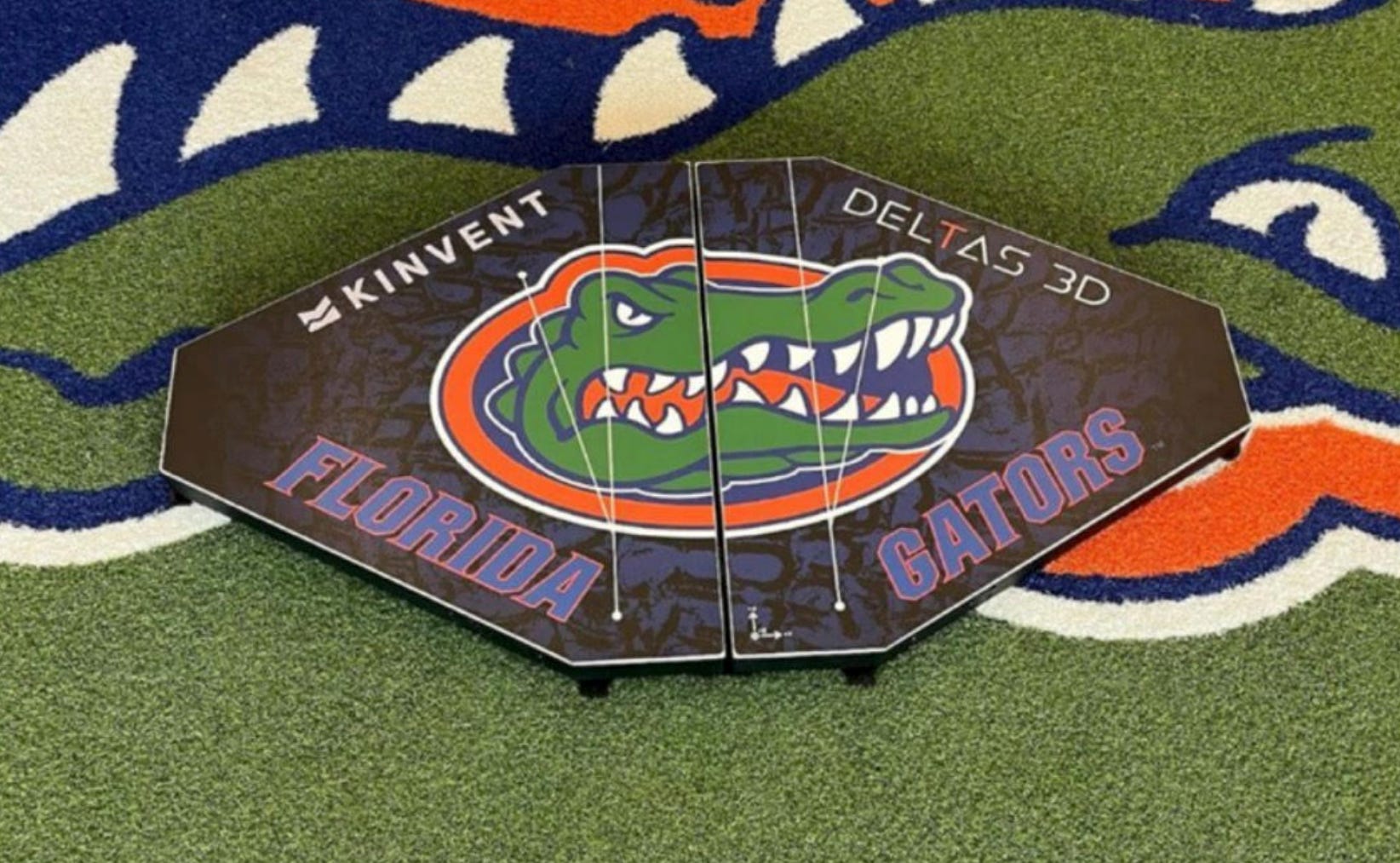
Here is a picture of the KINVENT’s 3D Deltas used by Florida Football and customized using the team’s logo.
Best Quotes: Here’s some of the key discussion points and best quotes from our conversation with Athan and Paul:
Q1. What are the Kinvent 3D Delta force plates and how do they work?
Athan Kollias
“Kinvent is now eight years old, and we’ve been working with force plates for five to seven years. This year was really a turning point for us because we decided to move toward capturing the full picture of human movement. Until now, most force plates on the market focused almost exclusively on the vertical component of force. With the 3D Deltas, we now calculate forces across all three axes—X, Y, and Z—which allows us to assess vertical, horizontal, and lateral forces. That means we can analyze not just simple movements like vertical jumps, but also complex movements such as changes of direction, lateral jumps, and broad jumps, which are much closer to what athletes actually do in sport.”
Q2. Decision to Adopt: What led you to adopt the 3D Deltas system?
Paul Silvestri
“The biggest reason for adopting the 3D Deltas was exactly what Athan just described. It was the first force plate system I had seen that could capture vertical, horizontal, and lateral forces all together. Traditional force plates give you vertical data, and that’s valuable, but it’s incomplete. When you’re looking at return to play, preseason screenings, or real on-field demands, athletes aren’t just moving straight up and down. The 3D Deltas were a game changer because they gave us a much more realistic picture of how athletes produce and absorb force in the movements they actually perform.”
Q3. Primary Use Cases: How are you using the 3D Deltas?
Paul Silvestri
“Right now, we’re using it heavily in rehab and return-to-play, and it’s becoming part of our daily workflow. We adopted the technology over the summer, so starting in January we’re rolling it into preseason screenings to establish baselines. A good example was an athlete coming off a meniscectomy—we’re at the stage where he’s returning to running and cutting. Using the 3D Deltas, we were able to analyze his lateral movements and cutting mechanics, overlaying markerless video with force vectors. We could immediately show him how valgus collapse during landings was altering his force output and where he was losing power. That immediate visual and data-driven feedback created a coachable moment you simply can’t get with any other force plate system I’ve used.”
Q4. Standout Features: What stands out most in daily use?
Paul Silvestri
“The combination of markerless video and force data is incredibly valuable. Being able to show athletes exactly what they’re doing, how their movement patterns affect force production, and where power is being lost is huge for both rehab and performance. Another major feature is Smart Mode. I can run an athlete through an entire battery of tests without clicking between protocols—the force plates automatically recognize what test is being performed. That saves a significant amount of time. On top of that, if we want to create a custom test for a specific athlete, Kinvent is incredibly responsive. I can explain what I want, and within 10 to 15 minutes it’s built and uploaded into our system. That’s a new standard for me.”
Athan Kollias
“For me, what really stands out is the combination of 3D motion capture with force vectors. Motion capture alone shows joint positions, but when you combine that with force direction and magnitude, you can truly work on technique. You can see if the athlete is pushing at the right moment, placing their knee correctly, and applying force in the right direction. This combination allows practitioners to move beyond just measurement and actually coach movement quality.”
Q5. Value & Key Data Insights: What metrics matter most?
Paul Silvestri
“The force vectors are the biggest value for us. These are strong, powerful athletes, but strength alone doesn’t guarantee performance. If they’re not applying force at the right angles, they’re not maximizing their ability. With the 3D Deltas, we can immediately identify those issues, make coachable corrections, and then retest to see if performance actually improves. That applies not only to rehab, but also to healthy athletes who may not be using their strength and speed efficiently on the field.”
Athan Kollias
“A great example is lateral force application during jumps. Everyone naturally pushes slightly to the sides for stability, but if an athlete pushes too much laterally, they lose force that should be directed forward. This directly affects acceleration, especially the first step, which can represent nearly one-third of an athlete’s maximum speed. With three-axis force analysis, practitioners can identify these inefficiencies and help athletes use their muscular system in a much more effective way.”
Q6. Why should other college or pro teams consider using it?
Paul Silvestri
“I’ll be very direct—we have a competitive advantage because we have this system. You simply cannot capture this level of three-axis movement data with any other force plate. Athletes move in all three planes, and this technology reflects that reality. Whether you’re assessing return to play or optimizing healthy athletes, the value of this data is enormous. In my opinion, it should be in every program.”
Paul Silvestri
“There’s also a major mental component. Athletes don’t just see numbers—they see visuals, they see progress, and they feel improvement. That builds confidence, which is often the final barrier in return to play. The 3D Deltas help restore trust in movement while we’re rebuilding physical capacity, and that’s been eye-opening for me.”
Athan Kollias
“Lateral movements often reveal compensations athletes try to hide when they want to return quickly. Being able to see those compensations helps practitioners make better decisions. At the same time, from a performance standpoint, improving explosiveness, acceleration, and efficiency directly reduces injury risk. That’s why we believe the 3D Deltas have a strong role in both health and performance.”
Q7. Product Improvements: What would you enhance?
Paul Silvestri
“Honestly, it’s hard for me to say what I would improve. The system is flexible, progressive, and constantly evolving. The fact that Smart Mode exists alone changed our workflow. And when we want to explore a very specific movement pattern, Kinvent can build that test quickly. That level of adaptability makes it hard to ask for much more.”
Athan Kollias
“What we’re currently working on is multi-angle video capture. Right now, practitioners often rely on a single camera view. Soon, they’ll be able to analyze movements from the front, side, and back simultaneously. This will be especially valuable for complex tasks like change of direction, allowing coaches to evaluate joint angles, trunk position, and timing from every perspective.”
You may also like:


