

Today we have the honor of interviewing Mauricio Elizondo, the director of sports medicine, at Austin FC, an MLS team. Mauricio discussed his background, approach towards training, rehab and how he uses a cutting edge technology such as ThermoHuman.

Mauricio Elizondo, DPT, ATC, CSCS, CPSS, is the Director of Sports Medicine for Austin FC, the Major League Soccer club based in Austin, Texas, where he leads the team’s medical and performance support for the first team. With more than 15 years of experience in elite sports medicine and athletic training, Mauricio’s background includes work with professional organizations such as the Boston Red Sox, Los Angeles Dodgers, Toronto Blue Jays, and the ATP tennis tour, as well as owning a high-performance clinic prior to joining Austin FC.
He holds a Bachelor’s degree in Athletic Training from Oregon State University, a Master’s in Exercise Science from the University of Idaho, and a Doctorate in Physical Therapy from the University of St. Augustine for Health Sciences, and is certified in strength and conditioning and performance sports science. In his role, Mauricio integrates injury prevention, rehabilitation, and advanced monitoring strategies to optimize athlete health and performance throughout the MLS season.

Picture: Mauricio Elizondo
You can watch the video interview below by clicking on the Youtube link. You can also listen to the audio interview by clicking on the link at the top of the page:
📝Show Notes: During the interview with Mauricio, we discussed his background and path to becoming Director of Sports Medicine at Austin FC, including his experience in professional baseball, tennis, and private practice. He explained how working daily within a team environment allows for a more structured and proactive approach to injury prevention, with consistent monitoring, preseason testing, and long-term athlete management throughout the MLS season.
Picture: ThermoHuman
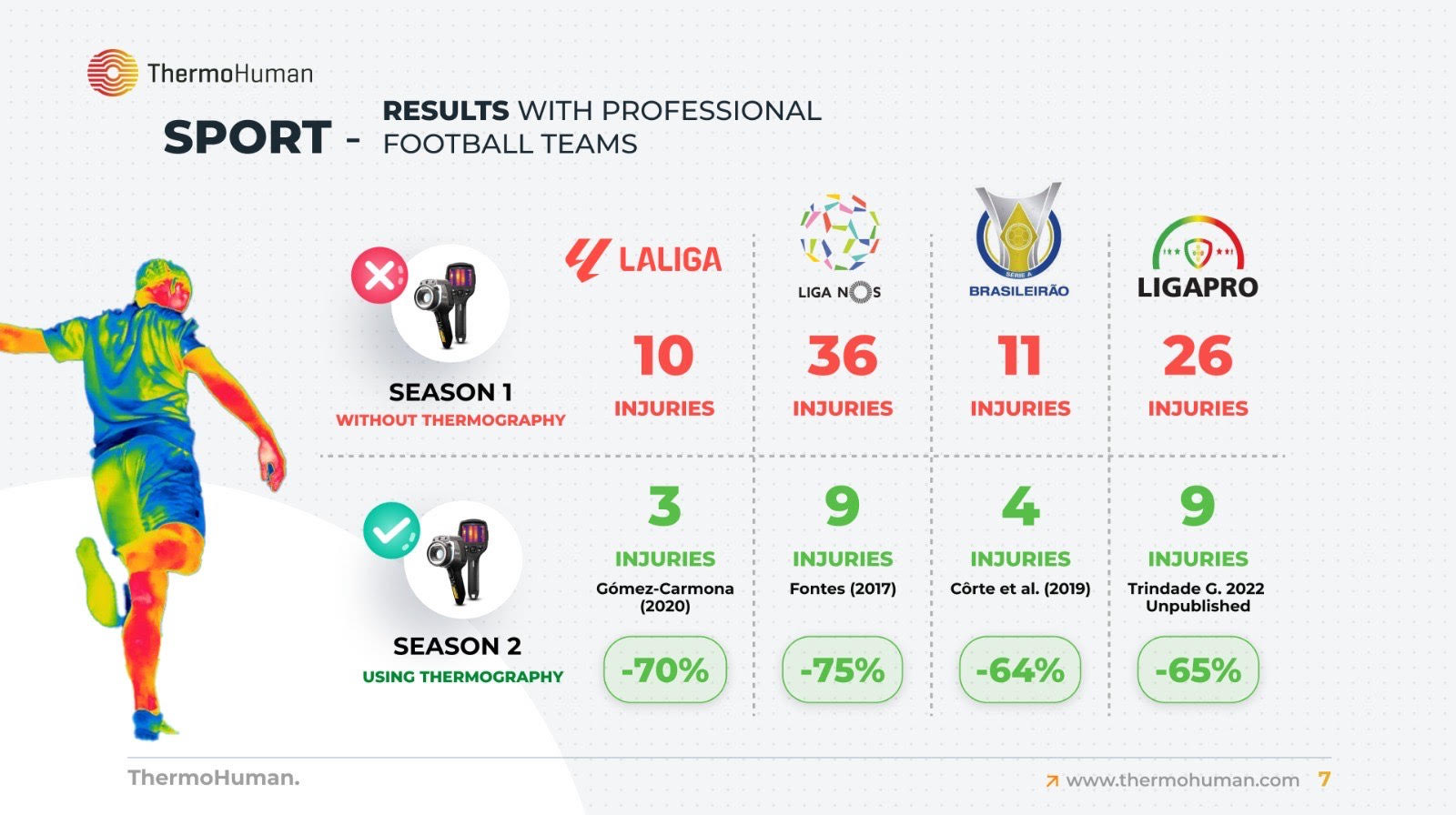
During the interview with Mauricio, we also discussed how Austin FC uses ThermoHuman as part of its injury prevention and load management strategy. He emphasized the importance of establishing individual baselines, monitoring temperature changes weekly, and interpreting results within context. Mauricio highlighted that thermography is a practical and efficient tool that provides actionable insights to guide recovery, adjust training loads, and help reduce injury risk.
You can read the full transcript of the podcast interview with Mauricio located at the top of this blog post.
Here are the quotes from the interview with Mauricio:
Q1. His Background
“I’m the Director of Sports Medicine here at Austin FC, and this is my third full season with the club. Before this, I had a pretty eclectic background. I owned a private practice in Florida for six years, traveled on the tennis tour for six years, and spent 11 seasons in professional baseball with organizations like the Red Sox, Dodgers, and Blue Jays. I’ve been fortunate to learn from a lot of great people along the way, but soccer has always been my passion. When the opportunity came with Austin FC, it was a no-brainer.”
“Injury prevention becomes much more effective when you’re with a team every single day. When you’re embedded with a team for 10 or 11 months straight, you can manage an injury from beginning to end. You can establish preseason testing, create protocols, monitor progress, adjust treatments, and truly build a philosophy around prevention. That daily consistency makes a big difference compared to more episodic environments like tennis.”
Q2. How He Has Been Using ThermoHuman
“We’ve been using ThermoHuman for two years now, and it’s been a great tool for us. From an injury prevention standpoint, we already measure the external side — strength, range of motion, movement patterns — but we also need to understand what’s happening internally. Thermography allows us to look at temperature changes, which give us insight into inflammation and fatigue that we otherwise can’t see.”
“We establish baseline measurements during preseason because every player is different. Even though we think everyone has the same core temperature, there are variations — especially in specific muscles or joints that may have had prior injuries. Once we know what’s normal for each athlete, we monitor them weekly and compare new data to their baseline.”
“If a player’s temperature is higher than normal after a game, we interpret that as an inflammatory response and shift toward anti-inflammatory treatments and recovery strategies. If the temperature is lower than normal, that usually indicates fatigue, and we may adjust load, reduce intensity, or modify training sessions. It gives us direction for decision-making.”
“Context is everything. ThermoHuman doesn’t tell you what the problem is — it tells you there’s a temperature change. It’s our job to interpret why that change is happening and connect it to training load, injury history, or match demands.”
“It’s also very practical. It takes about a minute per player. We can run the whole team through in 30 to 60 minutes, usually first thing in the morning before any treatments that could affect temperature. That makes it easy to integrate into our weekly routine.”
Q3. Why He Likes Thermography
“What I value most about ThermoHuman is that it’s practical and it gives you a treatment direction. It’s not just data for the sake of data — it helps guide interventions. You still have to interpret it properly, but it provides meaningful information that we can act on.”
“The biggest advantage is that it shows you something you can’t see. Players don’t know if their right hamstring is warmer than their left. They don’t feel small asymmetries in temperature. We can test strength and flexibility, but we can’t visually assess internal temperature without technology like this.”
“It adds another layer to our clinical evaluation. We can see tightness, weakness, or movement deficits with other tools, but temperature gives us insight into inflammation and tissue readiness in a way that complements everything else.”
“There really isn’t another tool that gives you this type of global thermal perspective. It fills a gap that other monitoring systems don’t address.”
Q4. Why He Would Recommend Thermography
“I think it’s worth the investment. There are many monitoring tools and wearables on the market, but when you look at the amount of information you get relative to the cost, ThermoHuman provides significant value. It gives you insight that you simply can’t obtain through other methods.”
“We often assume that after a hard session or a game, a player’s body temperature and inflammation return to normal by the next day. In reality, that’s not always the case. Thermography helps you see that objectively, and it allows you to educate coaches and staff on what’s actually happening internally.”
“There’s growing research around temperature changes and injury potential, and I think the field is continuing to evolve. From my experience, if you’re willing to interpret the data properly and apply it in context, it can be a very powerful tool for reducing injury risk and managing load.”
Q5. Advice for Teams Looking to Adopt Thermography
“My biggest advice is: don’t just look at the results and blindly follow what the system says. In today’s AI world, we sometimes rely too much on automated outputs. That’s a mistake. You have to interpret the data in context — the athlete’s history, their workload, their baseline profile.”
“Create strong baselines in preseason and be consistent with your measurements. The more consistent you are — same time of day, same conditions, same weekly routine — the more meaningful your data becomes.”
“Understand that players are different. For example, we have some Northern European players whose normal body temperature runs lower than others. If you don’t establish that baseline and interpret the context, you could misread the data.”
“If you implement it properly, analyze it carefully, and apply the results thoughtfully, it can absolutely help reduce injuries. And because it’s fast and practical — about one minute per player — it’s very doable within a professional team environment.”
You may also like:
📈 📹 Upside: Thermography Ecosystem Analysis (Key Vendors, Trends, Recommendations to teams)

Over the last decade, injury risk assessment has become a major challenge for many pro teams and leagues. As part of that, thermography has emerged as a new way for pro teams to help reduce the risk of injuries with high level of accuracy. This is having a profound impact on pro teams in terms of players’ monitoring, recovery or injury prevention.


