

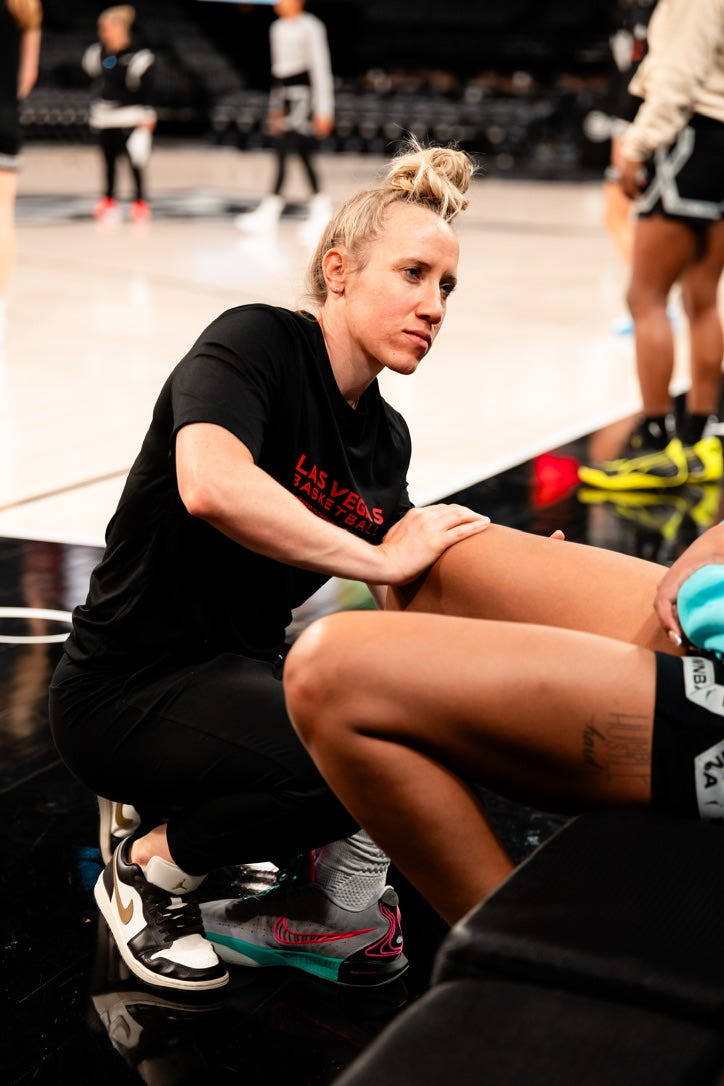
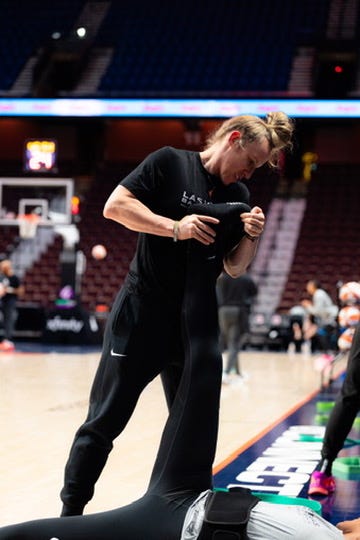
Today we have the honor of interviewing again Ciara Burgi, the director of health and performance at the Las Vegas Aces, a top WNBA team.

You can watch the video interview below by clicking on the Youtube link. You can also listen to the audio interview by clicking on the link at the top of the page:
📝Show Notes: During this interview with Ciara, we discussed how true athlete-centered performance starts with intentional individualization. She explained that in a WNBA environment, where roster sizes are small, individualization should be the standard—not a luxury. That means deeply understanding each athlete’s history, goals, recovery preferences, and role within the team, then aligning that with coaching objectives. Ciara emphasized adapting structure to environment, breaking down silos, and continually refining plans as relationships deepen over time. The conversation also explored the evolution of rehab and return-to-play, highlighting the shift from time-based protocols to more criteria-driven approaches that balance objective data with the human side of performance—confidence, fear, and function.
We also discussed innovation, technology, and leadership in high-performance environments. Ciara stressed that technology should enhance clearly defined values and systems—not replace them—and that teams must first identify the key questions they are trying to answer before collecting data. She underscored the importance of honest off-season reflection, resisting hype, and adopting solutions aligned with long-term goals. From a leadership perspective, she described curiosity as the foundation of trust—serving athletes and coaches through open dialogue, vulnerability, and follow-through. Ultimately, she highlighted that sustained success requires accountability and self-awareness, noting that “winning masks everything and losing magnifies everything,” and that elite organizations must remain honest even in victory.
You can read the full transcript of the podcast interview with Ciara located at the top of this blog post.
Here are the quotes from the interview with Ciara:
Q1. Individualization & Athlete-Centered Performance
“When we have 11 or 12 women, individualization should be the expectation—and if we’re not meeting that, I think that’s way below the bar.”
“Taking each athlete as an individual—getting to know them, their needs, what’s worked for them in the past, their goals, and the coach’s goals for them.”
“Us as practitioners taking what we know, combining that with what they know about themselves, and coming up with an individualized plan based on individual and team goals.”
“You just have to adapt the shape of your structure to the needs of your environment—and roster size plays a big factor in that.”
“Each year we should be dialing down and individualizing things better… because we know them better.”
“During the playoffs, we did a phenomenal job individualizing recovery recommendations during the most important time of the year.”
Q2. Rehab, Return-to-Play & Long-Term Athlete Health
“When I first started my career… I’m not sure I knew what a force plate was back then. I didn’t know what load management was back then.”
“We don’t want to go all objective and only based on data and forget about the human being in front of us.”
“At the same time, we can’t fully go based on feeling and ignore the technology.”
“What are our questions that we’re trying to answer? Not just collecting a bunch of data and then creating the question after.”
“ACL return to sport used to just be time-based… but time and quad strength measure impairment, not necessarily function on the field.”
“We need to define our values, define our principles, and figure out how to objectively evaluate those.”
“Those conversations are challenging because they require vulnerability—and not all staffs have safe spaces for vulnerability.”
Q3. Innovation, Technology & Smarter Decision-Making
“We can’t ignore creating values, principles, and systems—and then using technology to enhance and inform those systems as opposed to starting with technology to create the system.”
“If you don’t have your values strongly defined, you can look at a bunch of data and get overwhelmed.”
“What’s our biggest question? What’s our lowest hanging fruit that’s going to lead to the highest yield improvement?”
“Just because another team adopts something doesn’t mean it fits what we need.”
“Explore new technologies with a broad lens… maybe it doesn’t fit now, but three years from now it might be our lowest hanging fruit.”
“It’s taking an honest look at everything—does this align with our values?”
“The off-season is about reflection, being open to new things, and then dialing back into what you really need to make a big impact.”
Q4. Leadership, Communication & Trust
“Curiosity is at the foundation of everything.”
“We don’t know how to best serve if we don’t know how to serve.”
“If I’m just pushing my own agenda because that’s what I think is best, that’s honestly a pretty self-centered way to go about leadership.”
“As a leader, we’re here to serve.”
“How do I know how to serve you best if you and I can’t have an honest relationship and conversation about what your needs are?”
“There’s a lot of trust built up in following through with what you heard—because that means you’re listening.”
“Winning masks everything and losing magnifies everything—and neither are fully honest.”
“We’ll sit in victory and feel proud, and then we’re also going to have an honest look at what can be better.”
You may also like:
📚 Upside Analysis: The ACL Epidemic in Women’s Sports: Understanding the Rise in Injuries Across the WNBA and NWSL and How to Prevent Them

Anterior cruciate ligament (ACL) injuries remain a critical issue in elite women’s sports—particularly in the WNBA and NWSL. These injuries not only sideline athletes for 9–12+ months, but they also carry performance, psychological, and career longevity consequences. This report explores injury prevalence, evidence, case studies, prevention strategies, …


