

Today we have the honor of interviewing Brian Windell, President of Falcon Pursuit, a leading company scanning elite athletes for use in digital analytics.

Falcon Pursuit is a human performance optimization technology company that uses patented, advanced anthropometric infrared scanning and 3D avatar technology to capture highly detailed digital representations of the human body, enabling precise measurement of biomechanics, movement patterns, and physical form for real-time performance analysis and improvement. The platform delivers actionable data to optimize athletic performance, track progress, and inform personalized training and health decisions, and its technology has been applied with professional athletes, world-class companies, and elite sports organizations.
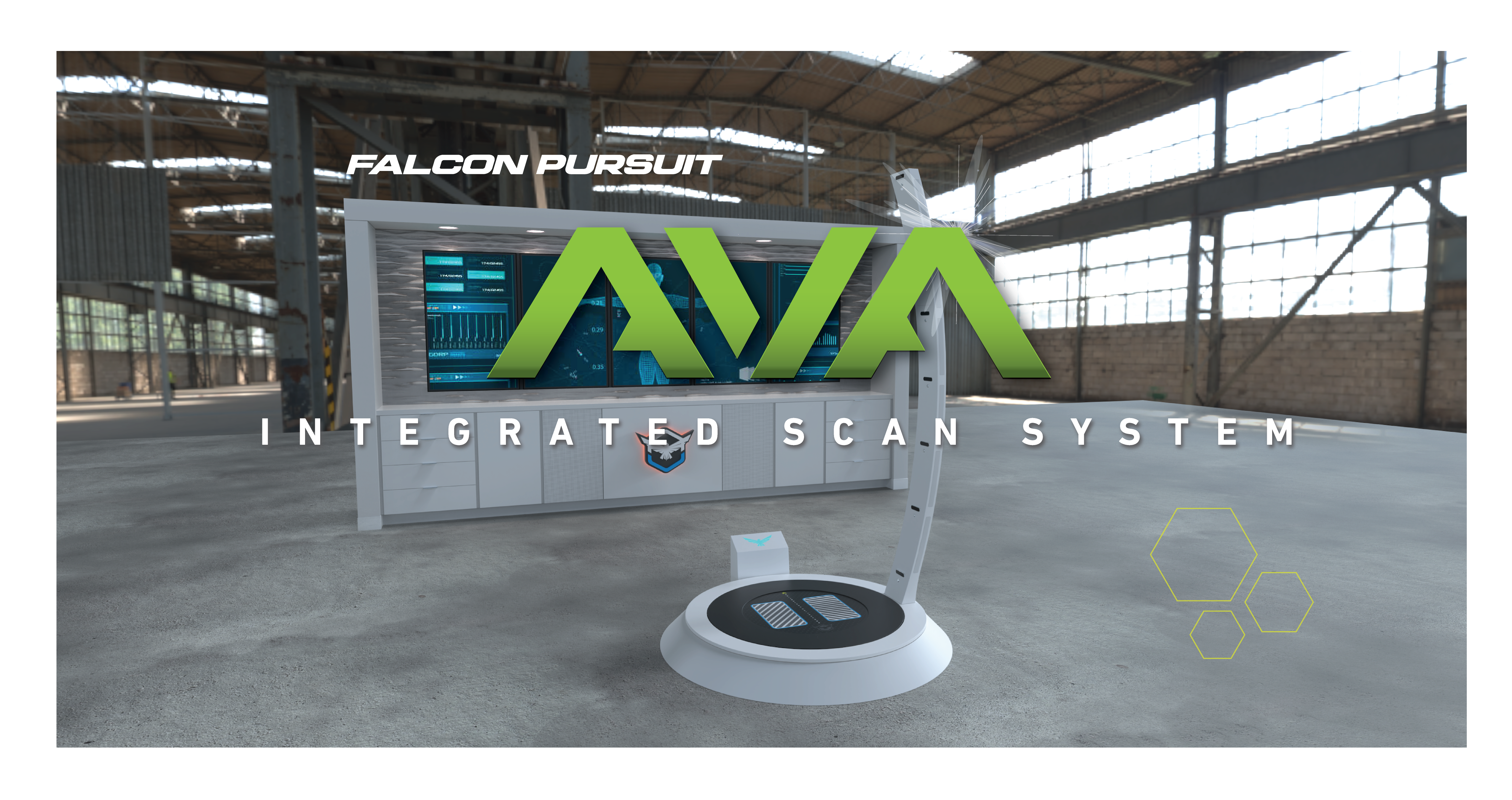
Picture: Falcon Pursuit’s AVA, body scan machine.
You can watch the video interview below by clicking on the Youtube link. You can also listen to the audio interview by clicking on the link at the top of the page:
📝Show Notes: During this interview with Brian, we discussed his background and the experiences that led him to Falcon Pursuit, including his early work in custom equipment fitting and motion capture, as well as the foundational role of the company’s patented technology. Brian provided an overview of Falcon Pursuit’s core product, the AVA system, explaining how its rapid full-body scanning creates fully rigged, anatomically accurate digital avatars. We explored how these avatars are used in elite sports to support motion analysis, real-time simulation, and performance evaluation across a wide range of sports and organizations.
We also covered the benefits Falcon Pursuit delivers to practitioners and teams, particularly through more precise, repeatable, and longitudinal athlete data that supports individualized training and development. Brian highlighted the company’s competitive advantages, including real-world simulation capabilities and career-long athlete tracking, before outlining Falcon Pursuit’s business model centered on hardware, platform access, and collaborative innovation. The conversation concluded with a look ahead at the company’s plans for the next 12 months, including scaling the AVA platform, launching new products, and expanding applications such as equilibrium testing and on-site 3D-printed performance solutions.
You can read the full transcript of the podcast interview with Brian located at the top of this blog post.
Here are the quotes from the interview with Brian:
His background and what led him to Falcon Pursuit
“What really led me to the company begins with our CTO, Jay White. This is all his brainchild. He’s been in custom-fitting equipment like shoes and helmets for decades, and his first patent actually goes back to 1982. What drew me in personally was my background working with a group at TaylorMade Golf in the early 2000s, where we were custom-fitting golf clubs using motion capture. That was really my first exposure to the avatar world, and it became clear that this technology could fundamentally change how we understand athletes and performance.”
Overview of their product
“Our main product is the avatar, and while that’s a term that gets thrown around a lot, ours is very different from what people usually think of. We scan athletes using our AVA kiosk, and that scanning session takes about 27 seconds. When it’s complete, you don’t just get a lifelike image—you get a fully rigged avatar that moves just like the human body. That’s where our patents sit, in the ability to automatically create a movable, anatomically accurate digital human.”
“We’re taking 360-degree dimensional measurements every millimeter from head to toe—each leg, each arm, every phalange, even facial structure. All of that data is captured in one-millimeter slices and converted into a rigged point cloud, which gives us a digital human that’s ready to be used in real-world simulations.”
Main use cases for elite sports
“We’ve been doing this for many years and have worked with hundreds of elite athletes across a wide range of sports—swimming, soccer, football, cycling, skiing. We’ve worked with organizations like the U.S. Ski Team, Auburn Football, and Red Bull. What’s powerful is that once you have the avatar, you can place that athlete into any digital environment—wind tunnels, aerodynamic testing, hydrodynamic testing—whatever parameters a coach or performance staff needs to evaluate in real time.”
Benefits for practitioners and teams
“When you really start to think about what you can do with a digital human being, it opens up a lot of possibilities. Teams can build databases of their athletes and use that information to optimize training on a daily basis. Strength and conditioning coaches can track very small changes in body shape, growth, and adaptation over time, which helps them make better, more individualized decisions for each athlete.”
“With our motion capture human tracker module, you’re not guessing where joints are based on AI assumptions. We already know exactly what that body looks like in motion, so we can calculate force, rotation, speed, and other key metrics with much higher accuracy. That’s qualitative data that practitioners can trust.”
Their competitive advantages
“Our main competitive advantage is the ability to place an athlete in real-world situations and get data in real time. This is head-to-toe, repeatable analytics that allow teams to track body changes across seasons and even entire careers. If an athlete joins a program as a freshman, you can follow their development all the way through to a professional level.”
“Programs like Auburn have had the system for several years, which means they can go back in time and compare incoming recruits to past high performers at the same position. That kind of historical context is incredibly valuable for evaluation and development.”
Current business model
“Our business model really wraps around the athlete avatar and the AVA system. We don’t just sell hardware—we provide simulation services, platform access, database building, training, and ongoing collaboration. All of the hardware is designed and built by us, and we work closely with teams to continue evolving the product based on how they’re using it in real performance environments.”
Plans and aspirations for the next 12 months
“The next year is a pretty exciting one for us. We’re launching AVA and scaling it to a much broader audience, and we also have new products that have been in beta testing for several years. One of those is our Equilibrium Protocol Program, where we take baseline data on an athlete and can identify whether their equilibrium has been affected after a significant hit.”
“We’re also already doing foot analysis and 3D-printing insoles on site for athletes, which saves teams both time and money. We’ve done this in soccer and skiing, and we’re expanding into braces and other equipment that can be customized and printed directly for the athlete.”
You may also like:


