
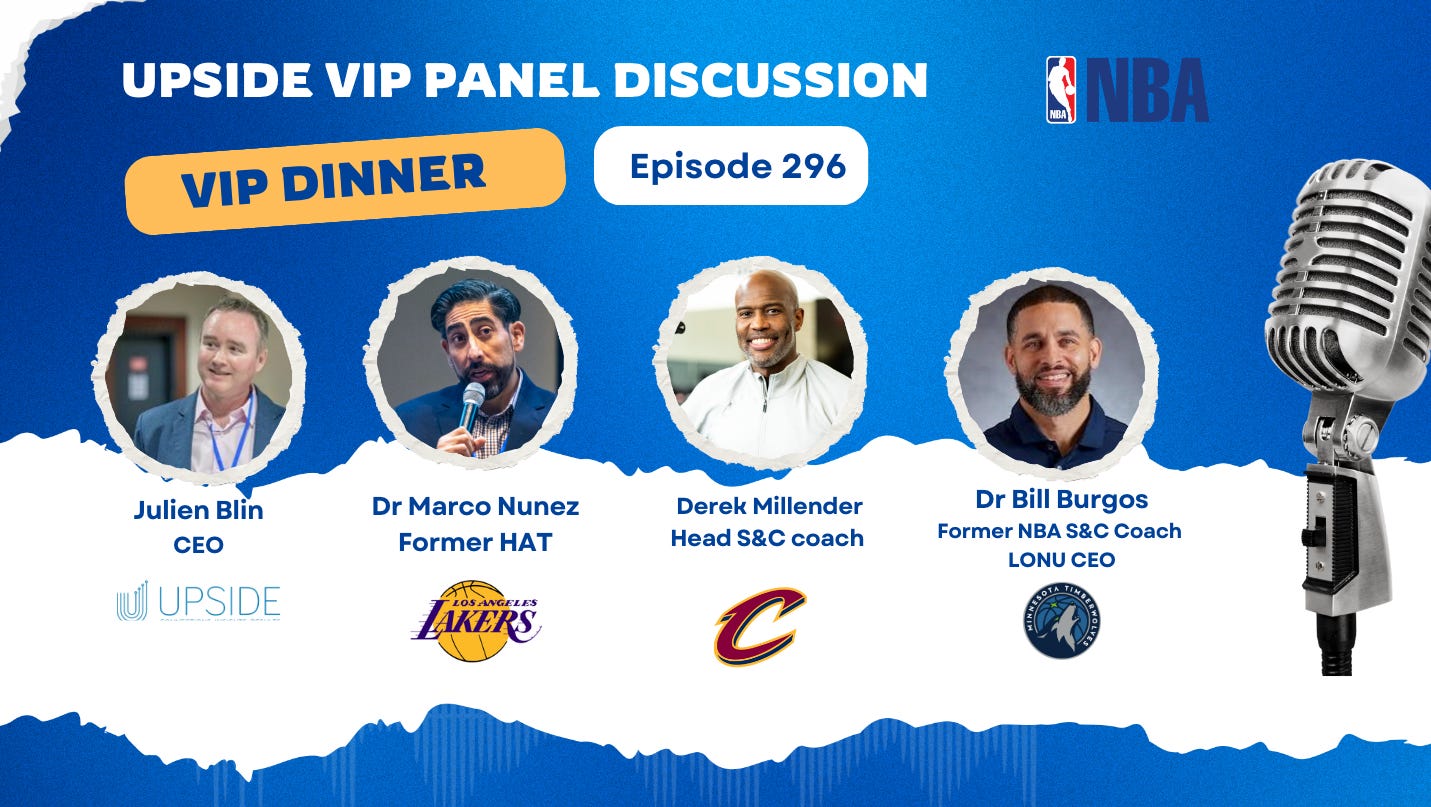
This week we have the honor to interview again a group of NBA sports performance executives to talk about the latest trends in the world of sports performance and rehabilitation.
Dr Marco Nunez, the former head athletic trainer for the LA Lakers (NBA).
Derek Millender, the head S&C coach for the Cleveland Cavaliers (NBA).
Dr Bill Burgos, a former NBA S&C Coach for the Orlando Magic, NY Knicks and Timberwolves. Bill is now the CEO of LONU, a nutritional platform.
Here are the topics that we covered during the video interview:
Q1. Use of wearables in the NBA:
Wearables are not currently allowed during live NBA games. There is only a list of approved wearables in the NBA during practice. Do you see the league’s stance on wearables evolving in the near future, especially as new technologies emerge?” How do you balance player privacy, data ownership, and competitive advantage when working with these systems?
Q2. Biomechanics Programs: The NBA is launching a league-wide initiative to install standardized biomechanics labs in all 30 team facilities to collect consistent data on player movement, aiding in injury prevention and performance enhancement. How will your coaching staff and strength and conditioning staff utilize the biomechanical feedback to modify training regimens or on-court techniques without overwhelming the player with technical information? What are the biggest logistical or cultural challenges you anticipate in getting players to consistently engage with the new biomechanics testing, given the already demanding NBA schedule?
Q3. “Micro-dosing” Training: Practitioners are using “micro-dosing” to provide consistent physical preparation during the season without over-draining players before competition. This approach seeks a balance between health, performance, and the demands of an 82-game schedule. What is your take on micro dosing training? Have you been using micro dosing training as part of your program? How are the benefits of micro dosing training in your opinion.
Q4. Training the “Brakes”: In the NBA, there is an emphasis on training deceleration (braking) in S&C programs, as basketball involves frequent stop-and-go movements. Improving this capacity is seen as key to success and injury prevention. Have you used such method as part of your program? What is your opinion on it?
You can watch the video interview below by clicking on the Youtube link. You can also listen to the audio interview by clicking on the link at the top of the page:
Here are some of the best quotes of our conversation with Marco, Derek, and Bill:
✅ Q1 — Use of Wearables in the NBA
Dr. Bill Burgos
“I think the league’s stance on wearables is absolutely going to evolve because the technology itself is evolving so fast. We’re seeing devices become smaller, more accurate, more predictive, and more relevant to real-time decision-making. Eventually the league won’t be able to ignore that. But at the same time, we have to be really thoughtful about the layers: where does the data go, who controls it, and how is it being used? Players want transparency. If they feel like the data is being used to support their health and longevity, they’re all in. If they feel like it could be used against them in negotiations or public perception, they’ll shut the whole thing down.”
“For us, balancing privacy, data ownership, and competitive edge comes down to trust. If a guy is wearing something on his body, he wants to know exactly what’s being collected and why. He wants to know how long it stays in the system, who sees it, and what decisions are being made with it. You build buy-in by making the process collaborative — otherwise you lose the room.”
Dr Marco Núñez
“Players are more educated than ever about data privacy. They want to know not just what we’re collecting but what the organization, the league, and the union are doing with it. If we can show them that the technology is there to help them extend their career, stay healthier, or reduce soreness, they engage with it. But the second they sense the data might be used for anything other than their immediate wellbeing, you lose trust. And trust is everything.”
“I do think the league is moving toward more wearable integration, but it’s going to be deliberate and player-driven. The union will have a major say, and they should. Because at the end of the day, these systems collect biological, movement, and physiological data that belong to the athlete first — not the team, not the league.”
Derek Millender
“We’re already getting a ton of value from wearables during practice and controlled environments — load tracking, movement trends, fatigue markers, asymmetry checks. But the minute you shift into games, it becomes a different conversation because you need to balance performance insights with privacy and competitive fairness. I think the league will eventually allow it because the upside is too big, but not until the players are fully protected and the rules are crystal clear.”
“With wearables, the message to players has to be consistent: this is for your benefit, not to grade you or use against you. When players feel the data is a partnership — something that helps them stay available and at their best — the buy-in is fantastic.”
✅ Q2 — NBA Biomechanics Labs
Dr Marco Núñez
“The biggest challenge isn’t collecting biomechanical data — we’ve been collecting data for years. The real challenge is communicating it in a way that makes sense to players. NBA guys don’t need twenty pages of analysis. They want one or two actionable changes: ‘Adjust this angle on your landing,’ or ‘Shift your foot here on your drive.’ If the feedback is simple and directly tied to helping them feel better or perform better, they’ll engage. If it’s too technical, you’ll lose them immediately.”
“And culturally, we have to remind players that biomechanics testing is not a judgment of their ability. These guys already feel like they’re under a microscope: media scrutiny, fan expectations, contract pressure. So before every test, I tell them: this is just a snapshot of how your body is moving today — nothing more, nothing less.”
Dr. Bill Burgos
“Biomechanics is going to help us identify the inefficiencies we can’t always see with the naked eye — things like uneven loading, compromised landing mechanics, or subtle asymmetries that creep in over a long season. But the key is translating those findings into coaching. If the data shows a player is overusing one side, the skill coaches might need to adjust how he attacks off the dribble or how he positions his feet on a cut. That integration between data and skill work is where the real value is.”
“But the cultural and logistical challenges are real. These guys already have a packed daily schedule: film, practice, treatment, lifting, recovery, travel. Getting them to show up consistently for biomechanics testing means we have to make the process fast, smooth, and obviously useful. If they don’t see the benefit right away, it becomes another thing they skip.”
Derek Millender
“The biomechanics labs will give us incredible insight — but you can’t throw every metric at a player. The approach has to be: here’s one cue, one drill, one adjustment that will make you more efficient. If you overwhelm them, you lose the opportunity. If you simplify the message, you get buy-in and you see results quickly.”
“Routine is the biggest challenge. NBA players live on routine. If the testing isn’t easy, quick, and seamlessly integrated, it won’t stick. So we have to build it into their rhythm in a way that feels natural rather than like another appointment.”
✅ Q3 — Micro-Dosing Training in the NBA
Derek Millender
“I’m a huge believer in micro-dosing because the traditional 60-minute lift just isn’t realistic during an NBA season. You’re traveling, practicing, playing, recovering — sometimes all in the same 36-hour window. Micro-dosing lets us keep players strong, explosive, and resilient without draining them before a game. Five minutes here, eight minutes there — you stack enough of those and you preserve performance all year.”
“We use micro-dosing all season long. Short priming sessions, quick power work, small clusters of high-quality reps — that’s the formula. It keeps strength from dropping, and players appreciate that it fits into their day without adding extra stress.”
Dr. Bill Burgos
“Micro-dosing is essential in the NBA. The schedule is too demanding and the players are too taxed for long gym sessions. When you can give them a targeted stimulus — a little eccentric load, a couple of heavy pulls, a few power reps — you keep the neuromuscular system sharp without adding fatigue. It’s about consistency, not volume.”
“The best part is that players actually buy in because it’s low-dose, low-duration, and high-impact. They feel the benefits without feeling worn down.”
Dr Marco Núñez
“From a medical standpoint, micro-dosing is one of the best ways to maintain tissue health over an 82-game season. Regular, small doses of load keep muscles, tendons, and joints prepared without overwhelming them. And mentally, players prefer it — a six-minute lift feels manageable on a back-to-back, whereas a full session feels impossible.”
“Micro-dosing is consistency without overextension. That’s the key.”
✅ Q4 — Training the “Brakes”
Dr. Bill Burgos
“In basketball, deceleration is arguably more important than acceleration. Anyone can run fast, but not everyone can stop efficiently. Most soft-tissue injuries — groin pulls, hamstring strains, even knee issues — happen when players can’t control the braking phase. So we spend a lot of time training how to absorb force, how to land properly, how to cut safely. Teaching a player how to stop is often the best injury-prevention tool you have.”
“Over the years, emphasizing deceleration mechanics has saved us countless injuries. It’s one of the core pillars of what we do.”
Derek Millender
“We absolutely train the brakes. If you can’t absorb force, you’re at risk — plain and simple. A lot of players are explosive, but they don’t know how to stop that explosiveness safely. When you improve a player’s braking capacity, you improve everything: their movement efficiency, their ability to change direction, their durability. It’s one of the biggest performance unlocks in the sport.”
“I tell guys all the time: speed is great, but being able to stop on command is what separates elite movers from everyone else.”
Dr Marco Núñez
“As a medical professional, one of the first things I look at with any player is how they decelerate — how they land, how they absorb a cut, whether the knee collapses, whether the hip is stable. Deceleration gives you more information about injury risk than almost anything else.”
“If a player can’t brake properly, the body starts compensating in dangerous ways. Training the brakes isn’t optional — it’s foundational movement health. Everything in basketball starts with how well you can control your own momentum.”
You may also like:
🔥Upside NBA Video Chat with Dr Marco Nunez (Ex LA Lakers/NBA), Derek Millender (Cavs/NBA), Ryan Petersen (Chicago Bulls / NBA) on The Life after the NBA, Technology Adoption, Performance Optimization

This week we have the honor to interview again a group of NBA sports performance executives to talk about the latest trends in the world of sports performance and rehabilitation.
🔥Upside Chat with Joe Rogowski, a Former NBA Strength Coach Athletic Trainer & Former Chief Medical Officer of the NBA Player Association.

Today we have the honor of interviewing Joe Rogowski, a former NBA strength coach athletic trainer. Joe is also the former Chief Medical Officer of the NBA Player Association. Joe is currently working with a number of organizations, including the NBA Retired Player Association and other industry players in the sports medicine area.
🔥Upside NHL Group Chat with Alexi Pianosi (Colorado Avalanche), Chris Stackpole (NJ Devils), Adam Douglas (Penguins)

This week we have the honor to interview a group of NHL sports performance executives to talk about the latest trends in the world of sports performance, load management, sleep/recovery management, rehabilitation and data & wearable tech integration, and mental performance in the NHL.
🔥Upside NFL Group Chat with Ted Rath (New Orleans Saints), Roderick Moore Jr (Pittsburgh Steelers), Ryan Juarez (Washington Commanders)

This week we have the honor to interview a group of NFL sports performance executives to talk about the latest trends in the world of sports performance, load management, sleep/recovery management, rehabilitation and data & wearable tech integration, and mental performance in the NFL.


