
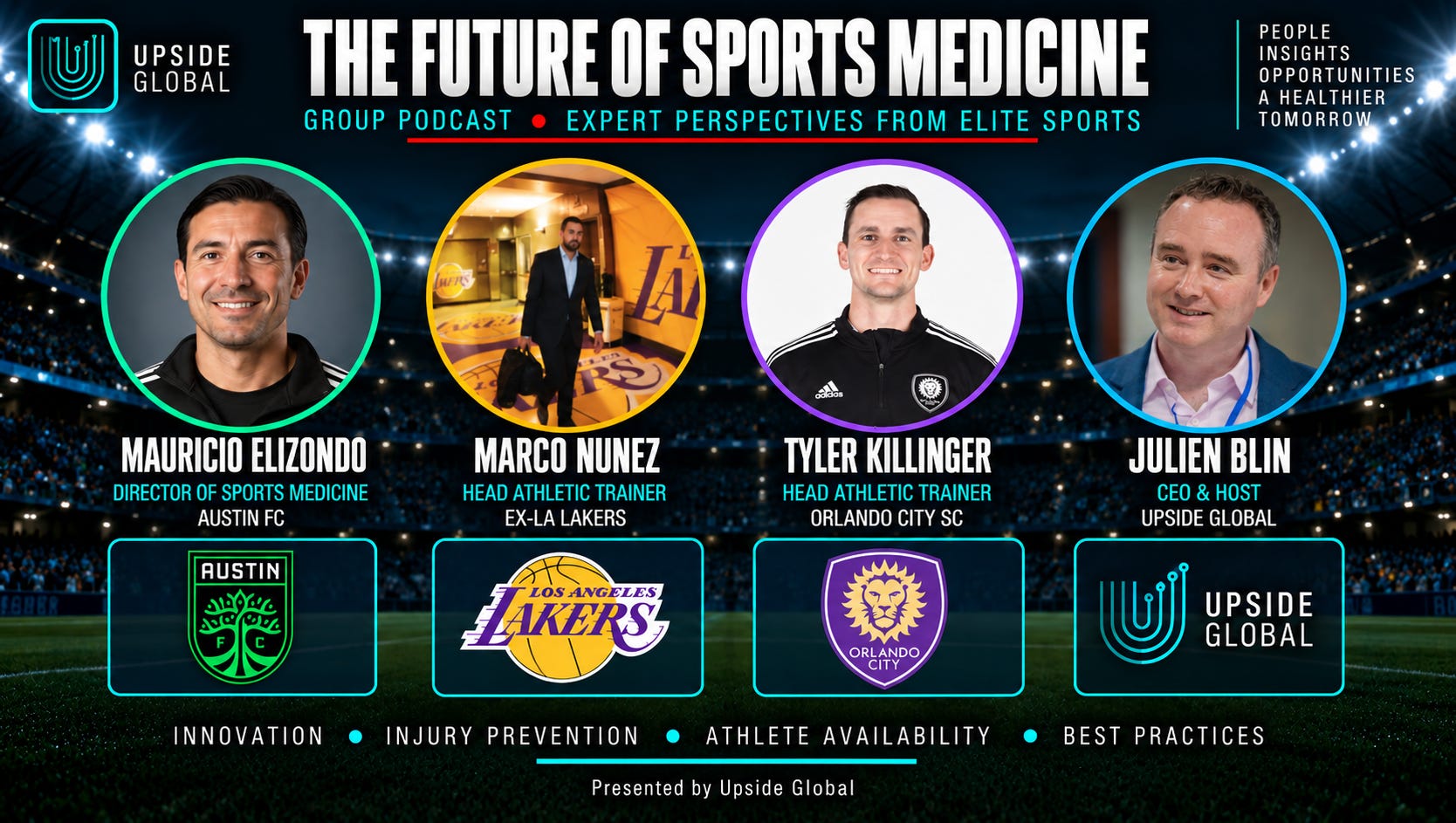
Today we have the honor of interviewing a group of MLS and NBA sports performance experts.
Mauricio Elizondo, Director of sports medicine, Austin fc (MLS)
Marco Nunez, Head Athletic Trainer, ex LA Lakers (NBA)
Tyler Killinger, Head Athletic Trainer, Orlando city SC (MLS)
📝Show Notes: Through this interview, we touched on the following questions and topics:
Q1. The current state of sports medicine:
How has sports medicine evolved over the past five years, and where are NBA and MLS organizations currently delivering the greatest value in injury prevention, diagnosis, rehabilitation and athlete availability?
Q2. Congested schedules, travel and load management:
With increasingly demanding schedules, extensive travel and limited recovery time, how should medical and performance teams balance athlete availability with long-term health? How do the challenges differ between basketball and soccerQ3. AI, wearables and injury prediction.
Q3. What are the best practices for lifting around games and while traveling in the MLS and NBA?
Q4. Teams now collect enormous amounts of information from wearables, force plates, biomarkers, imaging and athlete-management systems.
Which data genuinely influence your clinical decisions, and how realistic is the promise that AI can predict injuries before they happen?
Q5. Rehabilitation and return-to-play decisions.
What does best practice look like today when determining whether an athlete is truly ready to return? How do you combine imaging, strength and biomechanical testing, workload data, psychological readiness and the athlete’s own feedback?
Q6. The future of sports medicine.
Looking ahead five to ten years, which developments could most significantly transform athlete care—earlier diagnostics, advanced imaging, regenerative medicine, personalized rehabilitation, digital twins or AI—and which technologies are currently receiving more attention than the evidence justifies?
You can read the full transcript of the podcast interview located at the top of this blog post.
You can also watch the full video interview below:
Here are some of the best quotes of our conversation with them:
Q1. The current state of sports medicine
Marco Nunez — Head Athletic Trainer, ex-LA Lakers
“Every team nowadays has force plates, dynamometry and different performance tests. The NBA is now trying to create criteria where every team does the same sort of testing—to create consistency and a baseline for every player.”
Tyler Killinger — Head Athletic Trainer, Orlando City SC
“Sports medicine more and more is molding with sports performance. In the past, we saw these two separate silos—sports medicine keeping athletes healthy and responding when an injury occurs, and performance asking how we optimize. Now we’re really starting to work together as a better unit: How can we optimize these athletes? How can we prevent more? How can we get ahead of it?”
“Being able to track these athletes through the long seasons and through the many matches—trying to monitor an athlete as best as possible through those demanding periods—is the thing that’s really evolving the most.”
Mauricio Elizondo — Director of Sports Medicine, Austin FC
“We’ve done a really good job with diagnostics and rehab. A hamstring rehab is probably 50% of our rehabs in a season, and I think we’re in a very good direction because we know how to treat. Now we’re exploring what goes before that—the prevention and the monitoring. I think that’s where most of sports medicine is going to go over the next five to ten years.”
Q2. Congested schedules, travel and load management
Marco Nunez
“Recovery began as soon as the game was over. With the Lakers, we had a whole hydration program postgame, customized compression tights for the plane, and we would talk to coaches about modifying or avoiding morning shootarounds and letting players sleep in. Sleep is the number one method of recovery compared to anything else.”
“These guys are professional athletes. They’re getting paid millions of dollars, but they’re also humans. You have to work with what you have, and as sports medicine practitioners, we have to try to manage it and make the best of it.”
Mauricio Elizondo
“It depends on your relationship with the performance department, nutrition and all the different areas: How do you break that cycle of fatigue in the first 72 hours? You have to modify training based on who played the most, who is still in that inflammation stage and who didn’t play much and needs a harder training session.”
“Sometimes budget is an issue. Sometimes recovery or the length of the flight is an issue. Sometimes the city is an issue. It’s multi-departmental communication—you need to be mindful of all the details.”
Tyler Killinger
“On a normal week in MLS, we’re Saturday to Saturday, so for the most part our go-to is: ‘Let’s get home.’ Let’s play the game, get on the plane and allow our guys to be where they’re most comfortable, which is their homes. The curveball comes with the midweek games, and then it becomes case by case.”
“You have to figure out what works for your athletes and what works for your organization to really find what prioritizes and optimizes the best.”
Q3. Best practices for lifting around games and while traveling
Mauricio Elizondo
Mauricio emphasized that lifting has to be adapted to the athlete’s minutes and the match schedule:
“When we have a week in between games, the middle of the week is usually when we do our loading, and that’s when the priority for a strength day would be.”
“If you have a guy that benefits from strength training but plays 90 minutes Saturday and another 90 on Wednesday, then maybe your strength focus changes to more of an isometric-type day—a little less of the power stuff or the heavy strength stuff that you would do in a normal week.”
He also discussed using alternative methods when recovery has to take priority:
“There are other tools now that we use for that. We can use BFR, which has shown it could be just as good of a stimulus on that day. But it depends on the athlete. Maybe an athlete has a chronic problem—that is the priority at that point.”
Marco Nunez
Marco explained that postgame lifting in the NBA doesn’t necessarily mean a conventional heavy strength session:
“In the NBA, we would do postgame workouts or lifts, but I wouldn’t call them lifts, so to speak. It depends on the individual athlete. If they played a lot of minutes, they would do more of a recovery lift.”
And the workload was very different for players who hadn’t played:
“Other athletes that played zero minutes would get an actual, somewhat larger lift, but then they would also do some treadmill or sprinting, some interval running, and try to get the cardio. Every individual athlete would do something different.”
Marco also made an important distinction about heavy lifting vs. postgame work:
“Even after the postgame lifts, they weren’t really heavy, heavy lifts. That would be more in between the days, during the quote-unquote off days. It wouldn’t be a true lift in that sense postgame.”
Tyler Killinger
Tyler highlighted one of the practical differences between MLS and the NBA when teams are traveling:
“Especially looking at post-match lifts, I think in MLS a hurdle that we hit is when you’re on the road, you don’t have access to a full gym. Whereas maybe the NBA and other leagues have access to some equipment.”
When Orlando is at home, players who haven’t accumulated enough match load can do additional work:
“Those guys who didn’t put in as many minutes—their load wasn’t as much—they will have a small lift after the match. And in soccer, the guys who don’t get as many minutes or any minutes at all, you’ll see them doing runs after the game on the pitch.”
His explanation of why teams do this is probably his strongest quote from this section:
“The concept is to do our best to try and get the whole team at roughly the same load, the same demand, so that we can still have the team on roughly the same schedule.”
Q4. AI, wearables and injury prediction
This produced some of the strongest quotes in the entire conversation.
Tyler Killinger
“We’re in this era where the concept is ‘more is more’—you want to collect everything you can and throw everything at the athlete. But you need to answer the question: What’s actually useful? You can gather every piece of information you want, but if it just looks pretty on a chart and isn’t actionable or causing an impact for the better of the player and the team, then why are you doing it?”
“AI should start to streamline that process and make it easier. But it still has a long way to go to really provide those benefits of, quote-unquote, ‘predicting’ injuries. We still have to make sure the clinician understands it, understands why we’re doing it and can communicate it effectively.”
Tyler also gave an excellent example of why athlete feedback cannot be replaced by objective metrics:
“An athlete literally turned and said, ‘I honestly don’t care what your data says. I didn’t feel comfortable doing that. I didn’t feel confident doing that.’ Your number in theory could be perfect, but what is the athlete actually presenting about it as well?”
Marco Nunez
“We can collect all this data, we can have AI, but AI doesn’t consider the human element. The data we collect is basically there to help us analyze and come up with a reasoning or reduction of risk. Does it guarantee or predict injuries? No, it does not predict injuries.”
“Too much data may be a lot of data. You can start muddling the water when you have all this data coming in and you don’t know what to do with it. Take one form of data—whether it’s force plates, sweat analysis, whatever it is—and perfect it. Get comfortable with it, and then slowly add stuff to it.”
Mauricio Elizondo
“Every data point is only useful if you have good timing, good context and validity. There are many companies approaching us saying they’re measuring this or that, and they might not even be measuring what they say they’re measuring.”
“AI is inevitably going to hit everywhere, and we’re going to have to use it to our advantage, but we also have to very carefully analyze and contextualize it. The human body has too many variables. We just need to make sure that we contextualize the data.”
Q5. Rehabilitation and return-to-play decisions
Mauricio Elizondo
“Return to play is multifactorial. The best return-to-play decisions now are made by the player himself, the staff and the front office. Everybody has to be on the same page.”
“The naked eye can also tell you a lot when you’re looking at a player on the field. We have a lot of criteria, but that criteria is more of a range rather than one specific target.”
Marco Nunez
“We’ve gotten a lot better. We have force-plate testing, dynamometry, camera motion sensors. We can measure valgus, pelvic tilt and change of direction with 3D and 2D cameras. But that’s just one data analysis.”
Marco’s strongest point was about psychological readiness:
“Athletes can be scared of creating that same mechanism that caused the injury. But once they go through that motion—maybe they pivot and turn—and realize, ‘Okay, that wasn’t bad,’ that becomes their aha moment: ‘Okay, this wasn’t as bad as I thought it was going to be.’”
Tyler Killinger
“We progressively expose them to the demands. Then we need to build their confidence and their body’s resilience to not only perform that action one time, but multiple times. We need to expose them to that in a controlled way.”
“At the very end, we check all of our boxes. You meet the metrics on the force plates, on the force frame, on the field, you’re meeting all your load—and then you also need that clearance mentally. At the end of the day, the athlete is the one who has to make that final say. We’re really just trying to provide them the tools to assist them through that process.”
Q6. The future of sports medicine
Marco Nunez
“Human performance was one of the big areas that developed with force plates and camera systems. Most recently it has become more biometric—with cortisol levels, blood analysis, peptides and all that. I think the next area may probably be the psychological aspect.”
Marco also offered an interesting longer-term prediction about how team medical departments themselves could evolve:
“Nowadays with regenerative medicine, biometrics and PRP, most athletes go out to specialists. It’ll be interesting if, in 10 or 15 years, every team has its own regenerative doctor in-house and does pretty much everything in-house instead of sending athletes out. That might be the next step.”
Mauricio Elizondo
“I think regenerative medicine is going to be improving over the next few years. At this point there are 10 different types of PRP injections and different types of stem-cell injections. We’ve gotten pretty good at the rehab and strengthening aspects—we know how to make something better—but players are going to want to play longer.”
“AI is also going to influence a lot—not necessarily our decision-making, but the processing of how we get to that decision-making.”
Tyler Killinger
“We’re going to continue to see advancements in tech. But regenerative medicine, biohacking—what can the athlete and clinicians actually do internally and tissue-specifically to either keep them healthy or recover them quicker? I think we’re going to see some very interesting studies and results coming out.”
Tyler also provided an important caution:
“It’s also a challenge with regulations and, at least for us, not wanting to experiment on a multimillion-dollar athlete. But I think we’ll continue to see advancements that become more tissue-specific and injury-specific.”
You may also like:
🔥Upside NBA Video Chat with Dr Marco Nunez (Ex LA Lakers/NBA), Derek Millender (Cavs/NBA), Ryan Petersen (Chicago Bulls / NBA) on The Life after the NBA, Technology Adoption, Performance Optimization

This week we have the honor to interview again a group of NBA sports performance executives to talk about the latest trends in the world of sports performance and rehabilitation.
⚽Upside NWSL Video Chat with Nicole Surdyka (Orlando Pride), Mitch Toda (North Carolina Courage), Juliet Barnes (Chicago Stars), On Workload, Travel, Female-specific health & injury prevention & More

Today we have the honor of interviewing a group of NWSL practitioners to discuss the latest trends and best practices related to women teams.


