
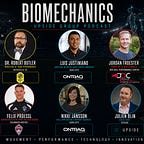

This week we have the honor of interviewing a group of experts in biomechanics in elite sports. We discussed the state of the market, the biggest barriers to a wider adoption, the main strengths and limitations of 3D markerless solutions, and how you see the space evolving in the next 5-10 years.
Dr. Robert Butler, Director of High Performance, Nashville SC (MLS).
Luis Justiniano, Director of Sales, Elite Sports Americas, Qualisys
Jordan Troester, Director of Performance, Red Bull Performance Center
Felix Proessl, Senior Director of Sport and Data Science, Colorado Rapids (MLS)
Nikki Jansson, Field Application & Support Engineer, Qualisys.
Here are the topics that we covered during the video interview:
How would you describe the current state of biomechanics in sports?
Where is biomechanics delivering the most value for practitioners today?
What are the biggest barriers to wider adoption of biomechanics?
What are the main strengths and limitations of today’s 3D markerless motion capture solutions?
How do you see biomechanics evolving over the next 5–10 years, and what role will AI play?
You can watch the video interview below by clicking on the Youtube link. You can also listen to the audio interview by clicking on the link at the top of the page:
Here are some of the best quotes of our conversation with Rob, Luis, Jordan, Nikki and Felix:
1. Current state of biomechanics in sports
Jordan Troester, Red Bull Performance Center
“Biomechanics is at an inflection point. Everyone believes it may hold answers to our injury questions, performance questions and everything in between. The technology is reaching the point where it can become point-and-click and user-friendly for strength coaches, athletic trainers and physical therapists.”
“Biomechanics lived in laboratories and universities for decades. Motion capture is now where force plates were 10 to 15 years ago: ready to move into practitioners’ hands.”
Dr. Robert Butler, Nashville SC
“Just because you can measure something doesn’t mean it will tell you what you want to hear. That is the humbling part of being a coach with new measurement tools: determining whether what you have always believed is actually producing the outcome you expected.”
“The technology is there. What interests me is how it will shape coaching curriculums, athlete-development programs and health programs—and whether it can motivate meaningful change.”
Luis Justiniano, Qualisys
“Historically, biomechanics was performed in a controlled environment with sophisticated equipment. It was a tedious process, and teams might wait a week for a report. By then, the actionable information they needed was often already late.”
“We are moving toward collecting more in-game data and comparing it with what we collect in the laboratory. Psychological pressure and other contextual factors can produce very different movement patterns.”
Felix Proessl, Colorado Rapids
“Markerless motion-capture technology has allowed practitioners in complex team sports to begin asking questions that were previously more accessible in controlled sports such as baseball.”
“In complex team sports, practitioners are trying to determine which pieces of that complexity can be simplified and placed into a repeatable, standardized testing battery.”
Nikki Jansson, Qualisys
“We are at a point of transition. We are not completely sure where biomechanics will go, but initiatives such as the NBA’s are helping other elite sports explore how this technology can benefit their programs.”
2. Where biomechanics delivers the most value
Jordan Troester
“I am most optimistic about use cases involving specific—and often individual—problem-solving. If you have a clear question, kinematics can provide deeper insight and help you make a decision.”
“The people who approach biomechanics with a specific problem-solving mindset will be more successful than those who simply capture everything and hope to learn from it eventually.”
Felix Proessl
“It needs to start with a question. A clear intervention and a clear question allow everything downstream—the collection, analysis and interpretation—to make sense.”
“The alternative is assessing 10 different movements simply because everybody else does it, without knowing why they matter to your environment.”
Dr. Robert Butler
“I am not looking at all 25 athletes coming through the system. I am looking for the two or three who need more attention than I anticipated.”
“Biomechanics can become another part of the signal—alongside sleep, wellness questionnaires, GPS data and conversations with the athlete—to help us understand athlete health and how that individual is organizing movement on a given day.”
“People typically respond consistently within themselves when they are fatigued, frustrated, worn down or approaching an injury. Identifying what is organic to that individual can be very powerful.”
Nikki Jansson
“Teams are using biomechanics in return-to-play initiatives and protocols. The important part is having the right staff to translate the data—not only to athletes and practitioners, but also to the front office so leadership understands the value of the technology.”
Luis Justiniano
“It is about asking the right question. If you collect a large amount of data but cannot manage it, you hit a wall and end up with a system that collects dust.”
“A coach wants to know whether movement changed—but, more importantly, whether that change was meaningful.”
3. Biggest barriers to wider adoption
Felix Proessl
“There is a mythical expectation that an optimal ground truth exists for movement. Athletes are some of the best compensators, and they operate within a range rather than around one perfect point.”
“The challenge is understanding what represents healthy and expected variability—and what represents unhealthy variability or movement outside the athlete’s normal boundaries.”
Jordan Troester
“As the capability becomes more widely available, people with less experience will be responsible for handling the data and interpreting the results.”
“There is a long process of education required to understand which metrics matter, what constitutes meaningful change and how much natural variability is associated with each measure.”
“Biomechanics will take off when the average person understands it well enough to find it useful.”
Dr. Robert Butler
“You cannot examine 697 variables related to speed, power, displacement, takeoff and everything else simply to find something—because you will find something. The question is whether it is meaningful and repeatable.”
“One reason biomechanics has not achieved wider adoption is that it is presented as everything, rather than as the one or two things that matter most.”
“It is no longer primarily a space or location issue. It is a purpose, intent and focus issue. The simpler we make biomechanics, the faster it will gain traction.”
4. Strengths and limitations of 3D markerless motion capture
Luis Justiniano
“The strength of markerless technology is scalability: moving from testing players occasionally toward testing them much more regularly, with less invasive systems that can adapt to indoor, outdoor and travel environments.”
“We must remain mindful of variability and accuracy. Whatever you measure at home must be repeatable when you test somewhere else.”
“A single-camera solution may be sufficient if you only need something simple, such as knee flexion. But rotational movements require multiple perspectives and triangulation.”
Felix Proessl
“Automation significantly reduces the time between testing and delivering information. That immediacy can make an enormous difference for coaches and athletes.”
“A limitation is that athletes know they are being tested and may change their behavior. Telling someone to ‘move naturally’ is much more difficult than giving them a clear objective such as jumping as high and as fast as possible.”
“That is why in-game assessment is so appealing. During competition, players are not thinking about being tested; they are trying to perform.”
Jordan Troester
“Visualization and reporting of kinematic data are critical for adoption. This information is still unfamiliar to many practitioners, creating a major opportunity for education and growth.”
Dr. Robert Butler
“The more cameras you have tracking points on the body simultaneously, the better your estimate of where those points are in space.”
“If the metric is meaningful enough, you can scale the clinical or performance question to the equipment available. The goal is to identify important metrics while minimizing friction.”
Nikki Jansson
“More cameras allow you to capture more data points and improve accuracy. A phone may be more portable, but it could be tracking only one plane of motion rather than the many data points available through a multicamera system.”
5. Future evolution and AI’s role
Luis Justiniano
“AI is a broad term, and there is a lot of misunderstanding around it. Computer vision is already part of AI, and we have been using it for a long time.”
“AI can help compile and flag information across multiple athletes and say, ‘There is something here—look into it.’ It should then be up to the practitioner to investigate.”
“We do not want AI telling practitioners that an athlete is red, yellow or green. We are not going to cross the line and pretend to be the experts interpreting the final result.”
Nikki Jansson
“AI is a powerful tool, but we need to be cautious about how it is used and make sure its outputs are not misinterpreted.”
“Practitioners are experts for a reason. Their education and years of experience must remain central to interpreting the data.”
Dr. Robert Butler
“AI will help only if it makes the search more efficient and focuses on meaningful questions that can lead to changeable outcomes.”
“Biomechanics may be more valuable for identifying signs of fatigue or changes in performance than for true injury prediction.”
“If you do not have a meaningful story connecting the analysis to what is actually happening, the information will become noise rather than a signal that creates change.”
“We are going to gain a better understanding of whether people are moving differently and whether that helps explain why the body is not functioning at its optimal level.”
Felix Proessl
“Optical tracking and pose estimation present an exciting opportunity for long-term evaluation and contextualization of performance during games.”
“The outcomes may be less detailed than laboratory measurements, but information such as body orientation, scanning rates and action types can still provide valuable technical and tactical insights.”
“GPS tells us how much high-speed running an athlete accumulated, but biomechanics and optical tracking can provide context about how that running occurred—whether it was linear, curvilinear, a recovery run or a run in behind.”
You may also like:

🎙️ Upside Video Chat with Luis Justiniano and Oskar Lindh at Qualisys, a leading provider of precision motion capture and 3D positioning tracking systems.

Today we have the honor of interviewing Luis Justiniano, a Sales Director - elite sports at Qualisys, a leading provider of precision motion capture and 3D positioning tracking systems. Luis is also joined by Oskar Lindh, Product manager at Qualisys.
📈 Upside Analysis: Markerless Systems and Computer Vision in Elite Sports: Key Trends, Drivers, Challenges, Vendors, Recommendations to Teams

Movement analysis is an essential component of elite sports, enabling teams, coaches, and athletes to gain insights into performance, injury prevention, rehabilitation, and tactical planning. Traditional motion capture systems required physical markers and specialized environments, limiting their application in real-world sports scenarios. However, adva…


