
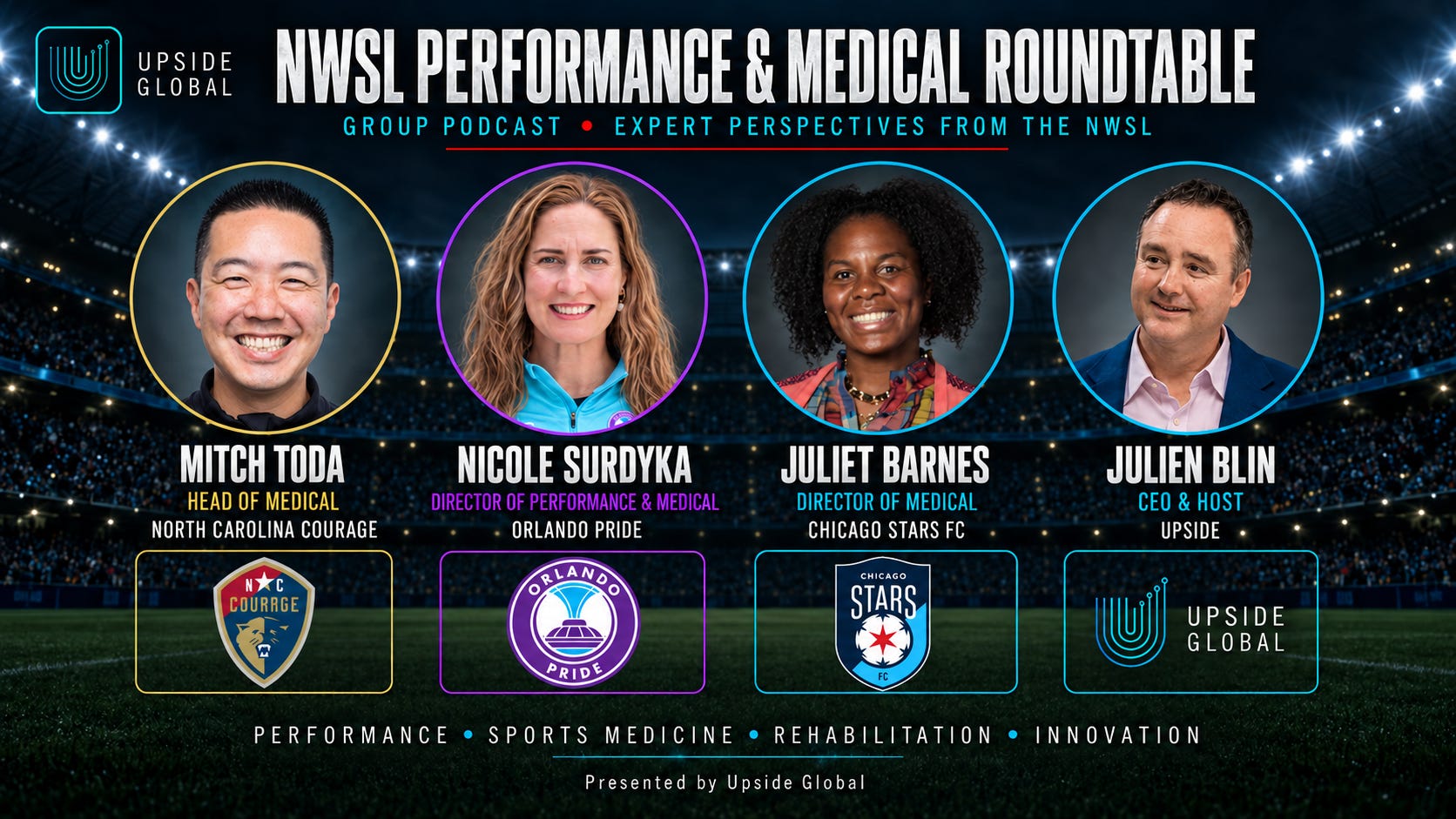
Today we have the honor of interviewing a group of NWSL practitioners to discuss the latest trends and best practices related to women teams.
Mitch Toda, head of medical, North Carolina Courage (NWSL).
Nicole Surdyka, Director of performance and medical, Orlando Pride (NWSL).
Juliet Barnes, Director of Medical, Chicago Stars fc (NWSL)
Here are the topics that we covered during the video interview:
The Current state of performance in the NWSL
How has the performance and medical environment within the NWSL evolved in recent years, and what challenges are practitioners prioritizing today?Female-specific health and injury prevention
How are clubs incorporating female-specific considerations—including menstrual health, pelvic health, nutrition and hormonal factors—into athlete care? What is being done to better understand and reduce ACL injuries?Workload, travel and player availability
How do you manage workload across the NWSL schedule, national-team windows and extensive travel while keeping players healthy and available? Where are the biggest opportunities to improve scheduling and recovery?Technology, AI and player data
Which technologies are delivering the most value to NWSL practitioners today? How do you separate actionable insights from data overload while protecting player privacy, consent and trust?The next five years
How do you expect health and performance practices in the NWSL to evolve over the next five years? What research, technology, staffing or league-wide standards could have the greatest impact on the women’s game?
You can watch the video interview below by clicking on the Youtube link. You can also listen to the audio interview by clicking on the link at the top of the page:
Here are some of the best quotes of our conversation with Nicole, Mitch and Juliet:
1. Current state of performance in the NWSL
Nicole Surdyka
“The biggest and most impactful change has been the increase in staff resources. We now have a very robust department, which makes things easier because people are not getting burned out as much. But it also requires intentional collaboration.”
“Historically, we have always asked what the women’s game can learn from the men’s game. This is an example where the reverse is also true. The women’s game has done a really great job of prioritizing mental health and mental wellbeing.”
Mitch Toda
“The collective bargaining agreement established a much higher baseline than what existed previously. Generally speaking, there are now more providers—and better-quality providers—supporting the players.”
Juliet Barnes
“The league has incorporated more checks and balances into player care, including mental health support and mandatory opportunities for players to complete screening. It is not enough to add staff; you also have to make sure players can access and use those resources.”
2. Female-specific health and injury prevention
Nicole Surdyka
“The menstrual cycle has often been cited as an obstacle to research rather than something to be embraced and studied further. Just because it adds another layer does not mean the research becomes drastically more challenging.”
“It needs to be done to empower the players. Every athlete wants to feel like she is being treated as an individual, and there is enormous variability in how athletes respond to their menstrual cycles.”
“My call to action would be: Don’t conduct research for the sake of doing it. Do it well. We need a greater quantity of research, but it also needs to be high quality.”
“I hope Project ACL does not take us down a rabbit hole of trying to link the menstrual cycle and ACL injuries. That narrative can be dangerous because it takes attention away from the factors we can actually change.”
Mitch Toda
“The purpose of Project ACL is that we simply do not know enough yet. We have extensive data from the men’s game and some emerging data from the women’s game, but much of it is not yet practical.”
“For now, we focus on proper periodization, wellness monitoring and appropriate weekly strength programs. We have to do the fundamentals well while remaining humble enough to admit that nobody has figured out ACL injuries yet.”
“I rely on specialists in areas such as pelvic health, OB-GYN care and nutrition. Every player responds differently, so the question is how we can support each athlete in doing her job despite how she may be feeling.”
Juliet Barnes
“Players do not want you to collect data simply for the sake of collecting it. The message has to be that the information is being gathered to help them perform—not to find a reason to remove them from training.”
“We can still support players through nutritional and other interventions based on their symptoms. What we should not do is say, ‘You’re on your cycle, so we’re going to modify your training,’ without truly understanding the individual athlete.”
3. Workload, travel and player availability
Juliet Barnes
“We have had to get creative with travel. If we are playing in the Bay Area and San Diego during the same week, we may remain on the West Coast for ten days. We bring the injured players and the necessary staff so everyone can continue progressing with their return to play.”
“Collaboration with national teams is extremely important—understanding when players are traveling, whether they are going overseas and whether they can arrive a day earlier to gain an additional day of recovery.”
“When a player returns from a long international tournament, we may give her five to seven days off, even if that means she misses a club game. We have to consider her total load.”
Nicole Surdyka
“Most soccer medicine research comes from Europe, where teams are not regularly flying six hours to play league matches. That travel has not been adequately accounted for in the way we periodize recovery and prepare players.”
“We have played an 8:00 p.m. game and then had to wake up at 4:00 a.m. for the best available commercial flight. If we know sleep is essential to recovery, what are we doing when players are getting only two or three hours of sleep?”
“When players return from their national teams, we do not always receive sufficient information about what they did. We may then have to tell the club that a perfectly healthy marquee player who just played four 90-minute games needs to rest.”
Mitch Toda
“The most successful teams typically have the greatest roster depth. Increasing squad depth would benefit not only player health but also the quality of the product on the field, because players would be fresher.”
“Charter flights could be a major game changer. If we truly want to support our players, that is a minimum standard the league should strive toward.”
“The worst-case scenario may be a player who goes to the World Cup, reaches the final stages but barely plays. She may actually detrain, creating another challenge when we have to rebuild her training load after the tournament.”
4. Technology, AI and player data
Nicole Surdyka
“We evaluate technology by looking at its total cost—in staff resources and money—and then comparing that with its impact. How much are we actually using it to make decisions?”
“If we are not making decisions from a technology, or if it does not weigh heavily in our decision-making process, we need to ask whether there is something else that should replace it.”
Mitch Toda
“We use wellness reporting, GPS monitoring and force-plate testing, but the goal is to use technology to support informed, collaborative decisions—not to say, ‘You are flagged red, so you cannot play today.’ That does not work.”
“Ultimately, we are working with people. The real value comes from combining the data with human interaction and getting an accurate picture directly from the player.”
“A red recovery flag does not necessarily mean the player cannot train. The player must remain a stakeholder in decisions about her own health and wellbeing.”
Juliet Barnes
“It is about the quality of what you collect, not simply the quantity, and about showing the players why you are collecting it.”
“Players need to see that the information they provide will not automatically cost them minutes or a place in the squad. Otherwise, they may not be honest or may not want to complete the questionnaire at all.”
“You need personnel who can digest the data and make it actionable. Otherwise, it is simply data sitting there.”
5. The next five years
Nicole Surdyka
“I would like to see an innovation team embedded within the club alongside the day-to-day practitioners. That team could answer the performance and medical questions practitioners do not have the time or energy to investigate.”
“That structure could eliminate the seven-year gap between academic research and its translation into practice. The answers could be developed and applied in real time.”
“This is an inflection point in women’s soccer. We can either inherit the negative aspects of the men’s game, including match congestion, or we can make different policy decisions before it is too late.”
“We need brave leaders who are willing to make difficult decisions for the women’s game right now.”
Juliet Barnes
“The league needs more specialized practitioners and a more female-centric ecosystem. Increasing staffing will be critical to supporting the players as the league continues to grow.”
“Larger rosters would also help teams rotate players and manage game load, particularly as more teams are added to the league.”
Mitch Toda
“The seasons will become longer, international demands will increase, there will be more teams, more games and more travel, and the game will continue to become faster and more intense.”
“The key question is how much of the research produced over the next five years will actually be actionable and implementable in player care.”
“A second-team league would provide an important buffer for injured players. Right now, an athlete returning from a long-term injury may have her first competitive exposure in an NWSL first-team game, which is an enormous challenge.”
You may also like:
🔥Upside Chat with Female Sports Experts: Allison Schmitt (Olympic Champion), Ciara Burgi (Las Vegas Aces / WNBA), Byrnadeen (Miami Marlins/MLB) on The Next Big Frontier for Women, and More

Today as part of our continued effort to bring more awareness on female athletes, teams and associated trends related to female athletes, we have the honor to interview a group of female sports performance experts:
🔥Upside Chat with Female Sports Experts: Laura Matthes (VivoSensMedical), Mélanie Pauli (Swiss Football), Kirsten Legerlotz (Humboldt), Saba Shakalio (FC St Pauli) on Female Research and More.

Today as part of our continued effort to bring more awareness on female athletes, teams and associated trends related to female athletes, we have the honor to interview a group of female sports performance experts:


