

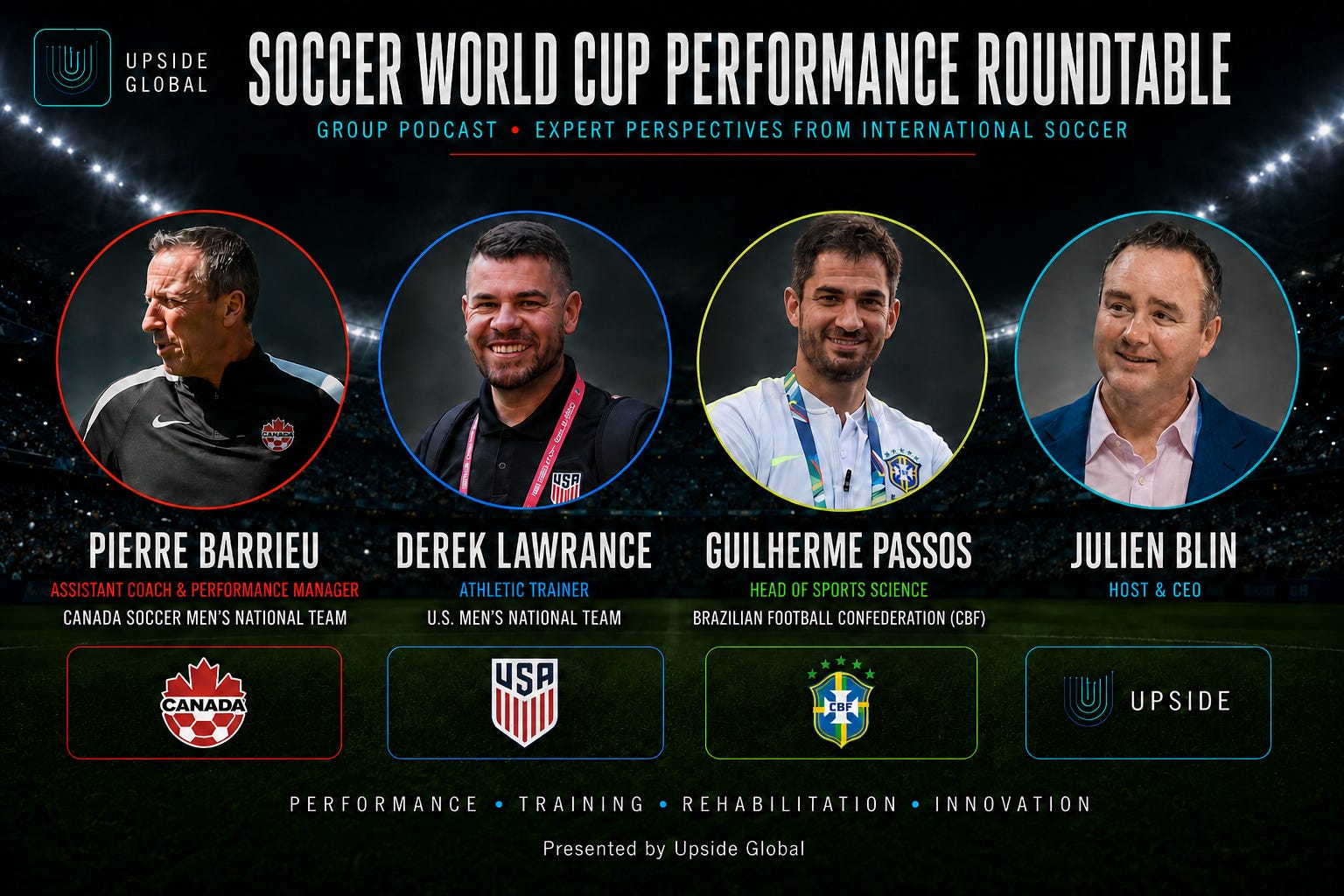
Today we have the honor of interviewing a group of experience soccer practitioners who have participated in soccer world cups including the latest 2026 Soccer World Cup in the US. The goal of this group podcast was to talk about their experience competing in the World Cup, the best practices, the does and don’ts.
Pierre Barrieu – Assistant Coach & Performance Manager, Canada Soccer Men’s National Team.
Derek Lawrance – Athletic Trainer, U.S. Men’s National Team.
Guilherme Passos – Head of Sports Science, Brazilian Football Confederation (CBF)
Here are the topics that we covered during the video interview:
The Reality of Preparing for a World Cup
Everyone talks about preparing for a World Cup, but what does that actually look like behind the scenes? What were the two or three priorities your staff focused on in the months leading up to the tournament that you believe had the greatest impact?Training vs. Recovery During a Congested Tournament
With matches every few days, how did your philosophy shift from improving performance to maintaining performance? How did you balance training, recovery, and keeping players fresh?Injury Prevention and Return-to-Play Under Pressure.
A World Cup creates enormous pressure to have your best players available. How did you approach injury risk reduction and return-to-play decisions when every match could determine the tournament?Biggest Lessons Learned
Looking back, what’s one thing you would absolutely do again—and one thing you would do differently—if you were preparing another national team for a World Cup tomorrow?One Key to Success
If you had to choose just one factor that has the greatest impact on keeping elite players healthy, available, and performing throughout a World Cup, what would it be—and why?
You can watch the video interview below by clicking on the Youtube link. You can also listen to the audio interview by clicking on the link at the top of the page:
Here are some of the best quotes of our conversation with Derek, Pierre and Guilherme:
1. The Reality of Preparing for the 2026 Soccer World Cup
Pierre Barrieu
“For us, the objective was pretty simple: we wanted to be healthy and fit. But we experienced an avalanche of injuries. I had more injuries with this Canadian national team than in the previous three World Cups combined.”
“We had ACL injuries, Achilles injuries, ankle surgeries and long-term concussions. It was one for the ages, but we managed it well—and the future is bright.”
Derek Lawrance
“Preparing for a World Cup is about using every camp beforehand to define how we will operate: how we assign responsibilities, monitor and screen players, and determine which technologies actually provide information we can apply.”
“We tried to replicate the World Cup environment as much as possible before the tournament so that the players could arrive feeling comfortable, relaxed and ready.”
“Even details such as the distance between the therapy room and the recovery area matter. If the recovery room is too far away, a player may simply decide to return to his room instead.”
Guilherme Passos
“Our main concern was understanding how the players would arrive at camp. Some finished their seasons two weeks before the World Cup, while others were still playing in the Champions League final.”
“We focused heavily on the training facility and hotel—making sure the physiotherapy and recovery areas were organized functionally so the players could use them easily and remain relaxed.”
✅ Summary - Key recommendations for teams
Prioritize player health and match fitness while maintaining contingency plans for late injuries.
Coordinate with clubs early and create individualized arrival, recovery and preparation plans.
Test staff workflows, monitoring technologies and operational processes before the tournament.
Design the hotel, training and recovery areas to make the players’ daily routines as easy as possible.
2. Training vs. Recovery During a Congested Tournament
Pierre Barrieu
“Having six days between matches allowed us to spend time not only maintaining performance, but also improving it.”
“When you have players returning from injuries, the additional days give you a better chance of getting them back and more time to focus on their individual needs.”
“Managing performance and recovery is much easier when you win, because so much of a team’s success comes down to the atmosphere between the players. When you win, there tend to be fewer conflicts.”
Derek Lawrance
“The longer cadence between games made a significant difference. We could play, recover, give the players a full day off and then follow a proper periodization plan going into the next match.”
“The additional recovery time allowed players to recover more fully and, if the training was managed properly, helped produce a better product on the field.”
Guilherme Passos
“The most difficult part of a World Cup is keeping the non-starting players fit. You often need those players during the most important stage of the competition.”
“Using youth players during the match-day-plus-one session can be an effective strategy for increasing the load on players who did not start and keeping them prepared throughout the tournament.”
“Microdosing strength training is one of the best strategies for giving players the strength stimulus they need during a World Cup.”
“Acclimatization was also a major priority. Most of our players compete in Europe, so we brought them to the United States almost ten days before the opening match to adapt to the conditions and the heat.”
✅ Summary - Key recommendations for teams
Individualize training according to match minutes, injury history and recovery status.
Prioritize recovery for starters while using match-day-plus-one sessions to maintain non-starters’ fitness.
Continue microdosing strength training and provide complete days off when possible.
Prepare players in advance for the tournament’s heat, humidity and time zone.
3. Injury Prevention and Return-to-Play Under Pressure
Pierre Barrieu
“We watch out for the safety of the players—not only for the World Cup, but for the short, medium and long term of their careers. We have an obligation not to put them at risk.”
“We spent countless hours communicating with club medical and performance teams, reviewing each player’s return-to-play plan and making sure we were aligned.”
“The timeline of a club may be different from the timeline of a national team. At the end of the day, we put the player at the center of the process and make sure his long-term future is not compromised.”
“We knew some players would not return to training or performance until potentially the fourth game. You can take that route with one or two players, but doing it with more would be irresponsible.”
Derek Lawrance
“Tournament results can dictate how you approach a player’s return. After clinching the group, we had ten or twelve days before the knockout match, which allowed us to buy additional recovery time.”
“In an all-or-nothing match, your risk tolerance may change. You consider what the player wants, the medical information and the match situation—but if the player is not adamant about pushing, perhaps you do not do it.”
“The player’s wishes matter, but the competitive situation also matters because it can dictate how the return-to-play process is structured.”
Guilherme Passos
“A return-to-play decision must always involve the player, the medical staff and the coaching staff.”
“We always prioritize the player’s health and safety, but there is a gray area when deciding whether a player should compete or remain out of the match.”
✅ Summary - Key recommendations for teams
Put the player’s long-term health at the center of every return-to-play decision.
Include the player, coaching staff, national-team medical staff and club medical team in the process.
Establish clear return-to-training, return-to-play and return-to-performance benchmarks.
Create an environment in which players feel comfortable reporting injuries early.
4. Biggest Lessons Learned
Pierre Barrieu
“I would always look to hold the preparation camp in challenging weather conditions so the team is better prepared for what lies ahead.”
“Playing at home created a great deal of excitement and emotion—perhaps too much at times. Managing that environment, including the presence of families, was more difficult than it would have been at an away World Cup.”
“Looking back, there is not much that I would change. We were very satisfied with how we approached the tournament.”
Derek Lawrance
“If an injured player’s clearance is going to come close to the final roster decision, I would bring him into the national training center early and spend a full week evaluating and rehabilitating him.”
“Having the player with us every day could allow us to deliver more treatment, better understand his potential and possibly shorten the return-to-play window.”
Guilherme Passos
“Using youth players to help prepare and maintain the fitness of the non-starting group is something I would definitely keep for the next World Cup.”
“Bringing an additional goalkeeper was extremely useful. It helped us balance the training load and avoid placing too much work on the remaining goalkeepers.”
“You cannot keep players in camp for 50 days without giving them a free day. I would place even greater emphasis on working with the technical staff to identify the right time to give the players time off.”
✅ Summary - Key recommendations for teams
Bring injured or borderline players into camp early for extended evaluation and rehabilitation.
Replicate the tournament’s expected weather and playing conditions during preparation.
Keep non-starters ready through competitive training sessions and carefully manage their workloads.
Schedule strategic days off and manage the emotional demands surrounding players and their families.
5. One Key to Success
Pierre Barrieu
“I have always had this dream of players sleeping in their own beds, on their own mattresses and with their own pillows. I believe that would be a massive advantage.”
“If we could provide every player with his own mattress and pillow at the base camp, I think it could give us the best return on our investment.”
Derek Lawrance
“The biggest factor is the players’ commitment to arriving in the best health and fitness possible—not simply doing enough to make the roster.”
“Players need to be open about physical issues before they become bigger problems. If they communicate with us, we have an opportunity to help them.”
“I understand why players may hesitate to report an issue because they fear they will not be selected, but hiding something can allow it to manifest into a more serious problem.”
Guilherme Passos
“We sent the players a questionnaire asking which pillows and mattresses they preferred. We then tried to provide those options at the base camp and purchase the exact same products whenever possible.”
✅ Summary - Key recommendations for teams
Prioritize sleep and reproduce each player’s preferred sleeping environment whenever possible.
Encourage players to arrive fully fit rather than merely healthy enough to earn selection.
Build trust so players communicate physical problems before they become serious injuries.
Create shared responsibility among players and staff for health, recovery and availability.
You may also like:
🎙️ Upside Chat with Pierre Barrieu, Director of Performance (Canada Soccer) & UEFA Technical advisor & FIFA Freelancer

Today we have the honor of interviewing Pierre Barrieu, the director of performance for the Canadian national men soccer team, and a technical advisor for the UEFA and also works as a freelancer for the FIFA.
🔥Upside Chat with Mike Messer (Nashville SC / MLS), Jason Han (Ex LAFC / MLS), Derek Lawrance (USMNT) On Major Factors to Develop Players, Mental Preparation and Load Management To Avoid Burnouts

This week we have the honor to interview again a group of sports performance executives to talk about the latest trends in the world of sports performance and rehabilitation.


