
This week we had the honor to interview a group of NCAA sports performance experts.
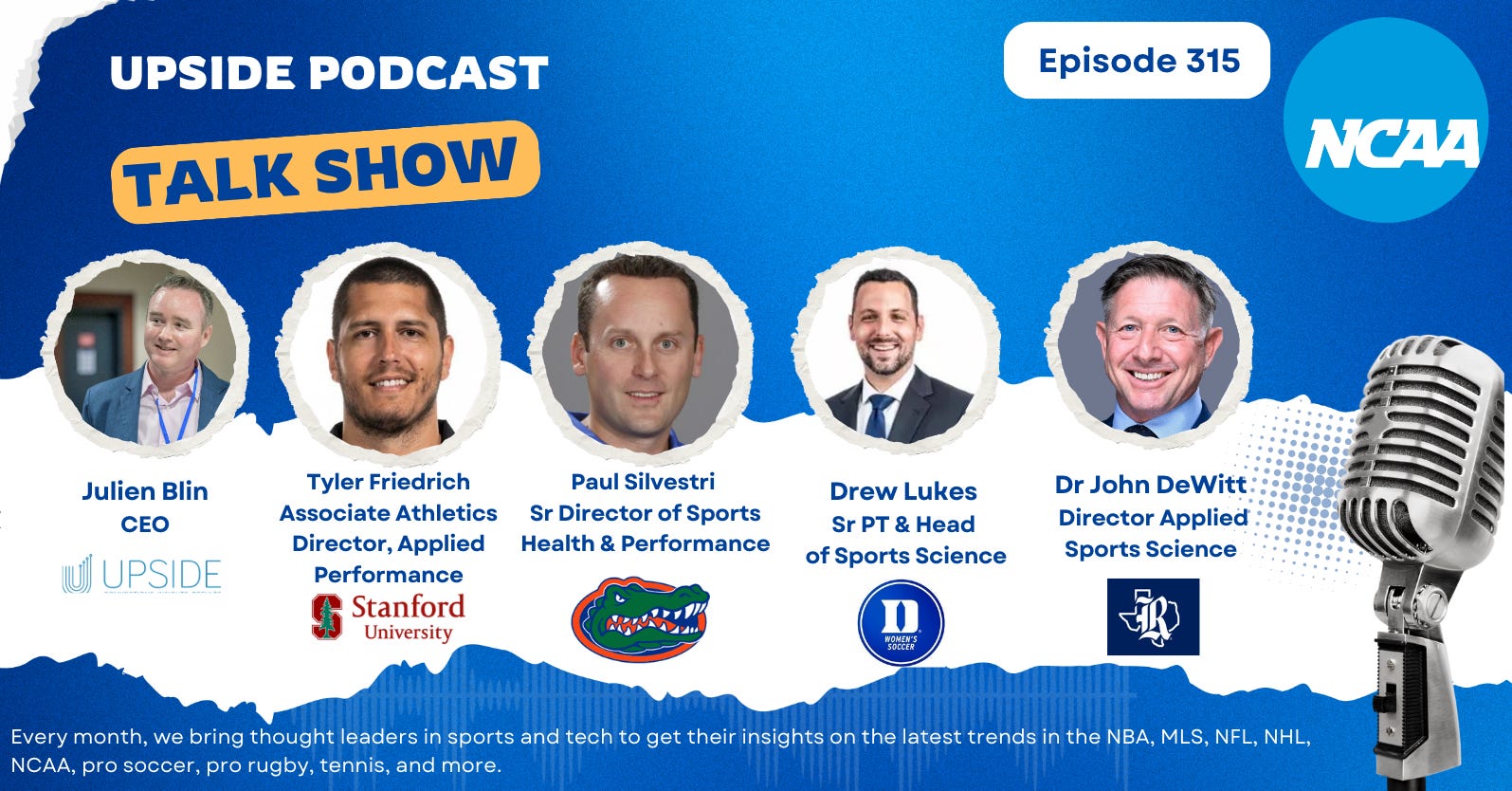
Dr. John DeWitt, Director of applied sports science in the athletic department and a faculty member, Rice University (NCAA team).
Paul Silvestri, Sr director of sports health and performance, University of Florida football (NCAA team).
Drew Lukes, Senior PT at Duke University and the head of sports science, Duke university’s women soccer team (NCAA team).
Tyler Friedrich, Associate Athletics Director, Applied Performance at Stanford University (NCAA team).
You can watch the video interview below by clicking on the Youtube link. You can also listen to the audio interview by clicking on the link at the top of the page:
📝Show Notes: Through this interview, we touched on the following questions:
Q1. Time Management
In a high-performance NCAA environment where demands are constant, how do you personally and professionally manage your time? Are there specific systems, tools, or habits that help you stay effective and avoid burnout?
Q2. Athlete Fatigue (Physical & Psychological)
Fatigue management is becoming increasingly complex. What methods or technologies do you rely on to monitor both physical and psychological fatigue in your athletes? And how do those insights actually influence your day-to-day decision-making?
Q3. Lessons Learned
Looking back on your career so far, what are some of the most important lessons you’ve learned? And if you had the opportunity to do something differently earlier on, what would it be—and why?
Q4. March Madness Predictions
With March Madness around the corner, who do you see as the team to beat this year? What stands out to you about their performance, preparation, or overall structure?
You can read the full transcript of the podcast interview located at the top of this blog post.
You can leave a comment by clicking on the button below:
Here are some of the best quotes of our conversation with them:
Q1. Time Management
Dr. John DeWitt
“In our environment, there’s always another question to answer or another dataset to explore, and if you’re not careful, you can spend all your time chasing analysis. What I’ve learned is that you have to weigh the value of the question against the time it will take to answer it. If the insight isn’t going to directly help improve performance or reduce injury risk, then it’s okay to say no. That discipline is critical—otherwise, you’ll find yourself stuck behind a computer all day without actually moving the needle for your athletes.”
Paul Silvestri
“One of the biggest lessons for me in managing time has been empowering my staff. I don’t set their schedules—one of my assistants handles that for the entire group. It gives them ownership, it builds trust, and it helps them create balance in their own lives. And that balance is huge, because when people feel good outside of work, they’re much more effective inside of it. For me personally, I try to recognize that there are going to be really busy stretches, but when things slow down, I make it a priority to invest that time back into my family and reset.”
Tyler Friedrich
“A huge key to managing time effectively is being extremely diligent with your front-end work. How you collect your data, how you store it, how clean and organized it is—those things determine how efficient you’ll be later. If you build strong systems and dashboards upfront, you can answer a lot of questions almost instantly instead of digging through hours of data. At the same time, we really emphasize taking advantage of downtime. In college athletics, there are moments—like breaks in the schedule—where you actually can step away, and we encourage our staff to use those moments because they don’t always come around.”
Drew Lukes
“One of the realities of working in this setting is that your time is not always your own. You can have a perfectly planned day, and within seconds, something urgent comes up and everything changes. So for me, it’s about being what I’d call ‘rigidly flexible.’ I try to block off time for things that matter—like working out or taking care of myself—because I know that directly impacts how well I can take care of others. It doesn’t always go as planned, but having that structure in place gives me a better chance to stay consistent.”
Q2. Athlete Fatigue (Physical & Psychological)
Paul Silvestri
“We use a lot of tools—GPS, force plates, different monitoring systems—but one of the biggest changes we’ve made recently was simply adjusting our schedule. Moving to morning practices gave our athletes more time during the day to recover, handle school, and just live their lives. The feedback has been incredible. Guys are telling us they feel more normal, less rushed, and more in control of their day. That psychological piece is huge. You can measure everything in the world, but if athletes don’t have the time and space to manage their lives, those tools only go so far.”
Drew Lukes
“For us, monitoring fatigue is really about building a complete picture. We use wellness questionnaires, but we fully understand their limitations. So we combine that subjective data with objective measures like force plate outputs, GPS data, and other performance markers. It’s not about relying on one metric—it’s about layering them together to create a profile of where the athlete is at. And beyond the data, a big part of it is education and trust. Athletes need to understand why we’re asking these questions and believe that being honest won’t negatively impact them.”
Tyler Friedrich
“We have more data than ever—force plates, GPS, wellness surveys—all feeding into our daily decision-making. But without strong relationships and proper education, that data doesn’t mean much. Sometimes the most valuable insight still comes from simply asking an athlete how they feel. And what’s interesting is that performance doesn’t always align with the numbers. You can have an athlete put up the best performance of their career on a day when their metrics aren’t great. That’s why our job is to use the data to inform decisions, not dictate them, and to always keep the bigger picture in mind.”
Dr. John DeWitt
“When we talk about fatigue, I think it’s important to distinguish between acute fatigue—what an athlete is feeling from recent activity—and chronic fatigue that builds over time across a season. The same data can help us identify both, but the interpretation changes depending on the question we’re asking. Ultimately, though, the data is just the starting point. When we see something change, that should trigger a deeper investigation—talking to the athlete, understanding context, and figuring out what’s really going on. And when it comes to psychological fatigue, we’re still largely relying on subjective tools like questionnaires. We don’t yet have a truly objective way to measure that piece.”
Q3. Lessons Learned
Dr. John DeWitt
“One of the biggest lessons I’ve learned is that coaches and athletes aren’t interested in the complexity of your analysis—they want to know what it means for them. Early on, I would get excited about the process and want to walk people through all the technical steps. But over time, I realized that what really matters is delivering a clear, actionable recommendation. The process is important for us, but the outcome is what drives impact.”
Drew Lukes
“We have a saying that really stuck with me: we take what we do very seriously, but we don’t take ourselves too seriously. Earlier in my career, I would take things very personally when something didn’t go as planned, and it would affect how I showed up day to day. Learning to separate those things—to still care deeply about the work but not let it define me—has been a huge shift and has made me a better practitioner.”
Paul Silvestri
“Early in my career, when something went wrong—whether it was an injury or a rehab setback—I would internalize it and take it very personally. Over time, you realize that even when you do everything right, things can still go wrong. That’s just part of the profession. The key is learning how to respond, how to adapt, and how to keep moving forward without letting those moments define you.”
Tyler Friedrich
“One concept that’s really shaped my approach is having strong convictions, but holding them loosely. I believe in what I do, and I’m confident in our systems, but I’m always open to evolving those beliefs based on new research, new experiences, or new perspectives. As you grow in your career, that mindset helps reduce pressure and allows you to be more adaptable, which ultimately leads to better outcomes.”
Q4. March Madness Predictions
Paul Silvestri
“If you had asked me before last night, I would’ve confidently said Florida—but after that loss, I think Arizona really stands out. They’re one of the most complete teams I’ve seen this year. They have a great mix of experienced players and young talent, and they seem to be playing really well together at the right time.”
Dr. John DeWitt
“I haven’t followed every team closely, but I’ll go out on a limb and say Houston. They’re playing in a familiar environment for this next stretch, which can be a big advantage, and they seem to be well-positioned to make a deep run.”
You may also like:
🔥Upside NCAA Group Chat with Paul Silvestri (Florida Gators/NCAA), Drew Lukes (Duke University/NCAA), Dr John DeWitt (Rice University), Tyler Friedrich (Stanford University) On the NIL

This week we had the honor to interview a group of NCAA sports performance experts.


