

Today we have the honor of interviewing Bryce Murphy, the Director of performance science and innovation, at the IMG academy, a premier sports-focused boarding school and training institution in Florida that combines college-preparatory academics with elite athletic development across multiple sports. IMG Academy also focuses on student lifestyle with leadership and character development.
Bryce Murphy is the Director of Performance Science and Innovation at IMG Academy in Florida, where he leads a team of five performance scientists, two performance analysts, and one PhD student supporting roughly 1,700 student-athletes across 12 sports. His path into sports science was nonlinear: he began college on an academic scholarship studying athletic training, pivoted to pre-med/pre-physical therapy, and ultimately found his calling in strength and conditioning, earning his CSCS and working as a personal trainer. A move to Minnesota led him into coaching, including a stint with Minnesota United in the NPSL and being named Minnesota’s competitive boys’ soccer coach of the year in 2018, while he served as a teaching assistant and pursued sports science research at the University of Minnesota under mentors including Tyler Bosch and Cal Dietz.
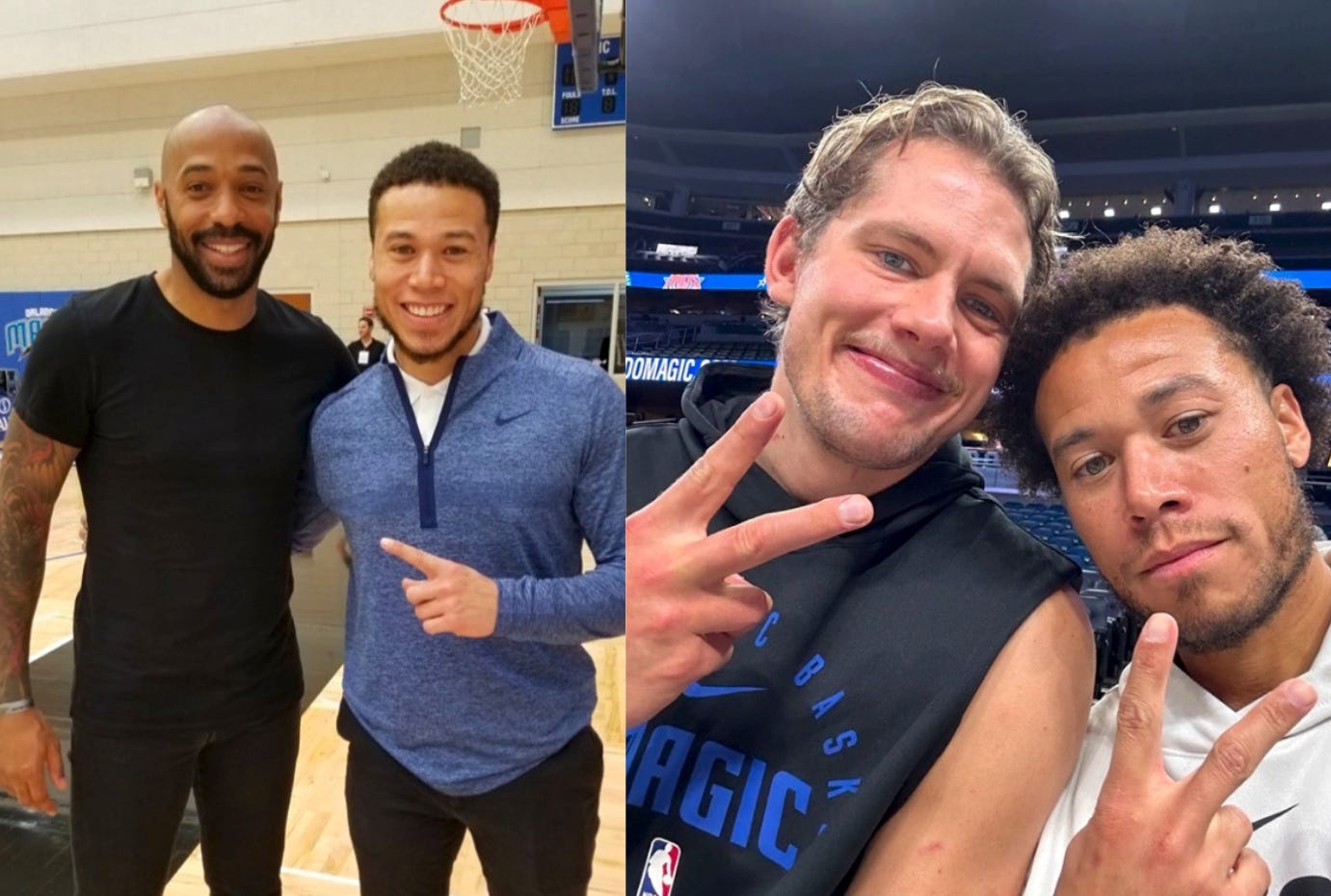
Pictures: Bryce Murphy with soccer legend Thierry Henry (Left) and Mo Wagner (Orlando Magic/NBA, right).
He then completed a fellowship with US Ski and Snowboard in Park City, Utah, working alongside biomechanist Bill Sands, before joining the U.S. Olympic and Paralympic Committee’s performance team to help build out the early version of what became the Athlete360 monitoring system. From there, he spent three seasons as an applied sports scientist with the Orlando Magic, taking on additional strength and rehab coaching responsibilities at various points, before moving to IMG Academy to help build out its athlete management system. He stepped into his current director-level role a little over a year ago.
You can watch the video interview below by clicking on the Youtube link. You can also listen to the audio interview by clicking on the link at the top of the page:
You can read the full transcript of the podcast interview with Bryce located at the top of this blog post.
Here are the quotes from the interview with Bryce:
Q1 – His Career journey:
“I’ve never been afraid to pivot, and I’ve always been really curious.”
“I took a course in strength and conditioning my senior year of undergrad, and I was like, ‘That’s what I want to do — I want to train athletes.’”
On his mentor in Minnesota: “He told me, ‘You need to learn how to code. You need to take all these biostatistics courses.’”
On building the first athlete-monitoring systems for Team USA: “It was really just the three of us typing away in that office, piecing it together with Tableau and R scripts.”
On getting the call that led to the Orlando Magic job: “Dave Tenney said to me, ‘I talked to two different people, and they both recommended you.’ We chatted for about 30 minutes, and then he asked when I could come down to Orlando for an interview.”
Q2 – His Current role at IMG Academy:
“There’s no typical day, given the scale of this place — we have 12 sports now, more than 80 teams, roughly 1,700 student-athletes, and about 150 to 200 coaches.”
“My team has five performance scientists, two performance analysts, and one PhD student. Together, that’s our Performance Science and Innovation Group.”
“You don’t necessarily learn leadership skills in grad school — you have to go seek them out.”
Q3 – His Athlete development philosophy:
“There’s no one-size-fits-all approach. It’s about asking the right question and implementing the right plan at the right time for that athlete.”
“We’ve broken it down into roughly five stages an athlete can fit into, and we build their environment around learning optimally at that stage.”
“The challenge can’t be too easy, but it can’t be too hard either, or the athlete gets discouraged. Finding that fine line is the goal.”
Q4 – Innovation and technology:
“AI is a key unlock for everyone, in any field — the ability to build rapidly at scale.”
“If you’d told me four years ago that I could describe what I wanted to an LLM and it would build it for me, I’d have said you were crazy.”
“It’s the old adage: garbage in, garbage out. We’re revamping our standard operating procedures to make sure our data is clean before it ever reaches our AI models.”
“At our scale, it’s nearly impossible for a human to track everything — but these systems unlock the ability to make better decisions.”
Q5 – Integrating training, rehab, nutrition, and mental prep:
“It starts with the human loop — every discipline is making decisions they believe are best for their group.”
“We run what we call the pod model: every week, leaders from each discipline come together, guided by shared dashboards, so everyone can see what everyone else is working on. There’s no lack of transparency.”
Q6 – Common mistakes young athletes make:
“There are two main mistakes: the first is no recovery — not leaving space for your mind and body to adapt.”
“The second is reps without purpose. Taking a thousand uncontested shots doesn’t help once you already have the technique down — there’s no challenge, no defender, nothing forcing you to adapt.”
“Skipping recovery and doing reps without purpose — it’s almost a waste of time.”
Q7 – The future of sports science:
“The age of information is coming to an end. Everything will live on the computer and be readily available.”
“The traits to cultivate are open-mindedness, curiosity, elite communication, and honesty — with yourself and with the people you’re working with.”
“Once we know everything about an athlete, the real question becomes: how do you build the habits that create consistency over time?”
“Computers will know everything about your athletes. The real differentiator will be EQ — how well you build relationships and communicate.”
You may also like:
🎙️ Upside Video Chat with Curt Truhe, VP of Health & Performance, Excel Sports Management, a Leading Sports Agency.

Today we have the honor of interviewing Curt Truhe, VP of Health & Performance at Excel Sports Management, a leading sports agency.


