

Today we have the honor of interviewing Mike James, head of coaching intelligence and strategy. Mike is joined by Shane Liyanage, the VP & head of tennis and Computer Vision at Orreco Tennis, one of the market leaders in performance analysis in tennis.

Orreco Tennis was born through the acquisition of Data Driven Sports Analytics (DDSA) in December 2025. It applies sports science, artificial intelligence and individualized athlete data to the specific demands of professional tennis. Its technology helps players and support teams monitor how intense matches, training sessions, international travel and short recovery periods affect performance throughout a tournament season. Orreco’s tools combine blood biomarkers, wellness information, workload data and movement analysis to identify fatigue, insufficient recovery and potential soft-tissue injury risks.
Through products such as the @thlete app, Recovery Lab, Motion Signal and its biomarker-monitoring platform, players can receive personalized recommendations related to sleep, nutrition, training and recovery. Orreco also provides female tennis players with menstrual-cycle-informed guidance through FitrWoman and FitrCoach. By bringing these insights into one performance system, Orreco Tennis helps players prepare more effectively for matches, recover between rounds and maintain their health and availability across a demanding season.
As shown in the video below, Orreco Tennis’ Trax platform uses AI-powered, three-dimensional skeletal tracking to analyze a player’s body positioning and movement patterns from video without requiring wearable sensors. By turning this movement data into biomechanical insights, Trax helps coaches evaluate technique, footwork and physical performance while identifying areas for improvement in training and match preparation.
As shown in the video below, Orreco Tennis’ PlayerDEX is a professional scouting and performance-analysis platform that organizes ATP and WTA data on serving, returning, groundstrokes, tactics, physical movement and pressure situations. It transforms live and historical match data into heat maps, three-dimensional court visualizations, player comparisons and automated scouting reports, helping coaches quickly identify strengths, weaknesses and opponent patterns
As shown in the video below, Orreco’s Tennis AI Agent provides a conversational interface that allows players and coaches to ask questions about match statistics, opponent tendencies, performance patterns and physical readiness using natural language. It analyzes Orreco’s connected tennis and sports-science data to produce charts, summaries and actionable recommendations that support scouting, tactical preparation, training and recovery decisions.
Trusted by Elite Tennis players
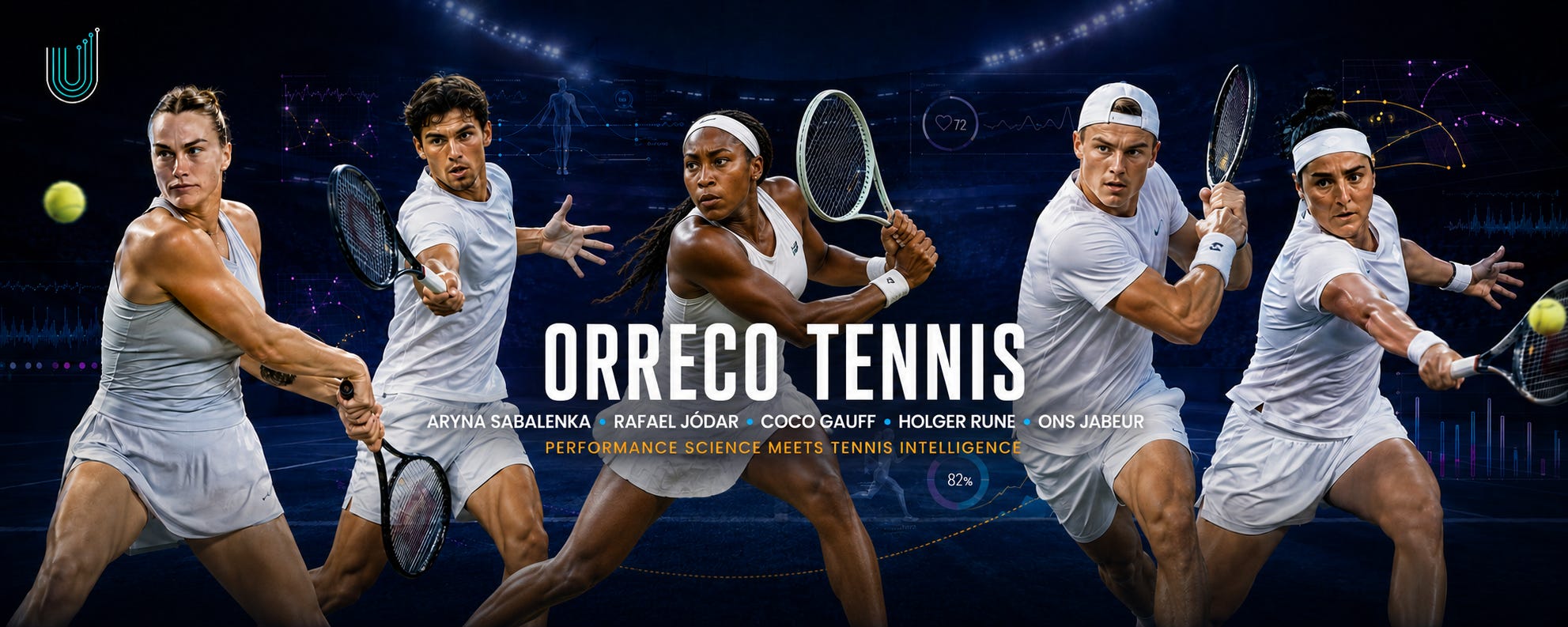
Leading players such as Aryna Sabalenka, Coco Gauff, Ons Jabeur, Rafael Jodar and Holger Rune, are among the players Orreco Tennis today. The combined Orreco–DDSA platform aims to connect these tennis-intelligence capabilities with Orreco’s expertise in biomarkers, readiness, recovery, injury management and long-term workload planning. This creates a more complete performance system that can help elite players understand both how to compete against an opponent and whether their bodies are prepared to perform.
In the video below, Aryna Sabalenka speaks with the Tennis Channel team about how detailed, opponent-specific game planning helps her prepare for high-pressure matches and rivalries. A key member of that process over the past six years has been data scientist Shane Liyanage, founder of Data Driven Sports Analytics (DDSA), whose analytical tools help transform match data into practical insights on opponent tendencies, tactical patterns and areas of opportunity.
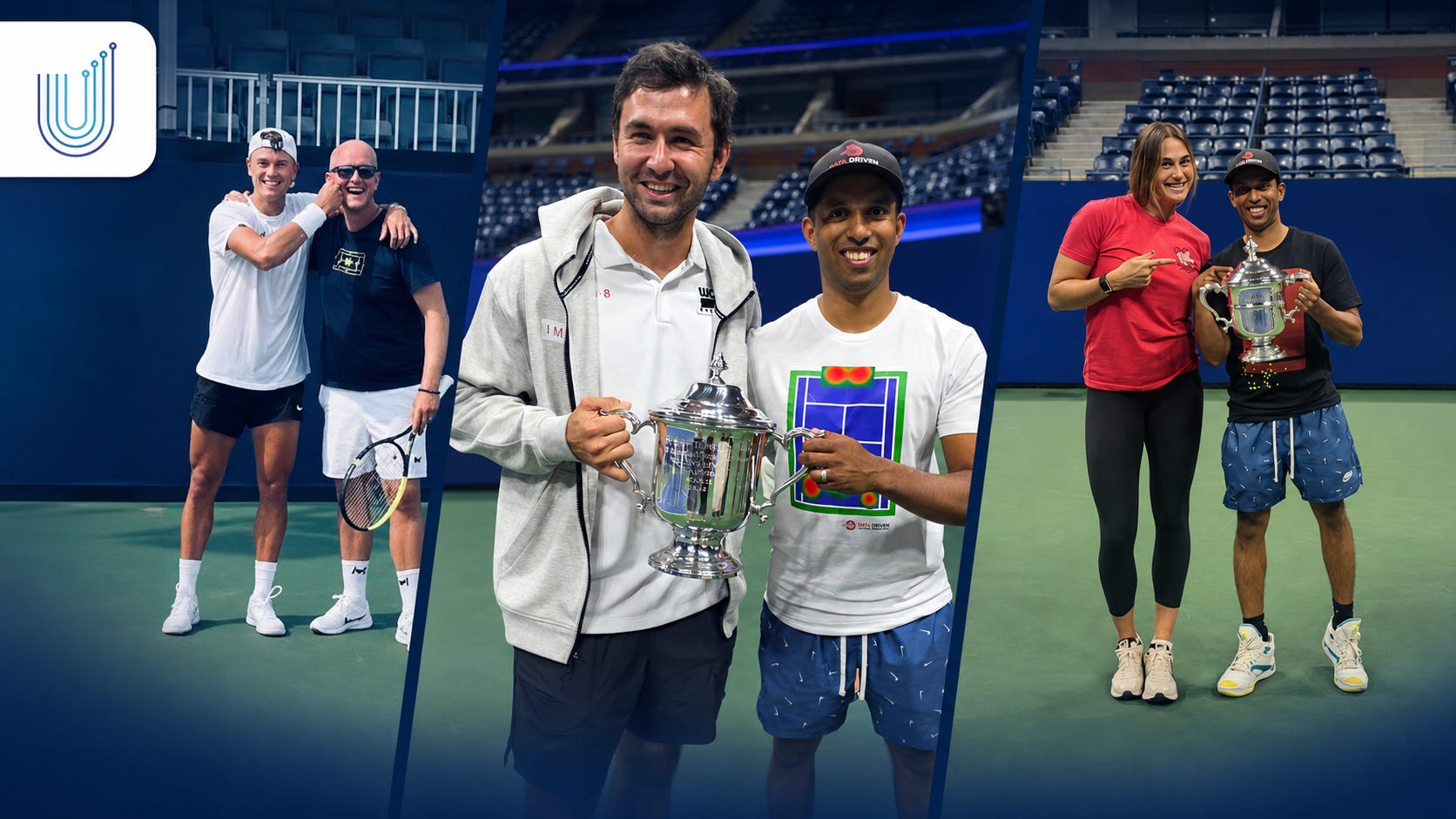
Pictures: Mike James with Holger Rune (Left); Shane Liyanage with Sabalenka’s coach, Anton Dubrov (center); Shane Liyanage with Aryna Sabalenka (right).
Liyanage works closely with Sabalenka’s coach, Anton Dubrov, and the rest of her performance team to ensure those insights complement coaching experience rather than replace it. Their collaboration demonstrates how data science, tactical expertise and player instinct can work together to identify small competitive advantages at the highest level of professional tennis.
You can watch the video interview below by clicking on the Youtube link. You can also listen to the audio interview by clicking on the link at the top of the page:
📝Show Notes: During this interview with Mike and Shane, we discussed their journeys to Orreco Tennis and how the company combines AI, computer vision and performance science to deliver actionable insights for players and coaches.
We also explored Orreco’s work with elite players, its AI Agent and rating system, and how technology can improve match preparation, decision-making and injury prevention.
You can read the full transcript of the podcast interview with Shane and Mike located at the top of this blog post.
Here are the quotes from the interview with Shane and Mike:
Q1. Mike and Shane’s journeys to Orreco Tennis
Shane Liyanage — DDSA and the Orreco acquisition
“With DDSA, we had reached the stage where we had a decision to make. We could take out a loan or raise more money to scale, look to merge with someone, or seek additional investment. At the same time, Orreco was looking to enter tennis, and I felt that bringing the two organizations together was a natural progression.”
“I always felt Orreco was the other side of the coin to what we were doing. Our focus was strategy and analytics—how to win a match and how to develop a player—but I felt we were ignoring, or not doing a good enough job of, the athlete’s recovery, injury management and return to play. Orreco complemented us in all of those areas, so the acquisition made sense.”
Mike James — coaching and performance analysis
“I come from a coaching and sports-science background, but I didn’t play professional tennis at the highest level. When I started working in tour and professional coaching, I was always using analysis—going back to manual charting around 15 years ago and then using Dartfish about 10 years ago. I felt tennis was missing the opportunity to do performance analysis at a really high level.”
“When I looked inside the performance-analysis departments in soccer, the NBA and the NFL, I could see that they were so far ahead of tennis it was incredible. I remember thinking, ‘We’re not even scratching the surface.’ I eventually set up my own company and then spent four years leading the performance-analytics department at the Mouratoglou Academy.”
“The opportunity to join Shane at Orreco didn’t require much convincing. You could see the holistic, 360-degree approach—covering every side of the athlete, from biomarkers and biomechanics to tactics. For me, it was a no-brainer. The energy, enthusiasm and ideas being created made me feel that I had to be part of it.”
Q2. What Orreco Tennis does
Shane Liyanage
“We’re not just a product. Yes, we have dashboards, an app, analytical outputs and video, but we are much more than that. We don’t simply say, ‘Here are 50 KPIs—go and analyze them and come up with your own conclusions.’ We work through that process with the player and the team.”
“For a specific player, we identify their strengths and opportunities and then ask how we can track those areas and provide meaningful feedback. That support might come before a match, after a match or during an offseason. There is a service behind the product, and we are also integrated into some of the teams, sitting in the player box, receiving live data and supplying the context that allows a coach to use it.”
“I think of computer vision, biomechanics, nutrition and performance science as parts of one large value chain. First, computer vision captures the data. Then you have the analysis, which might involve nutrition, strength and conditioning or biomechanics. Finally, there is the presentation: how do you communicate all of that in the most meaningful way to a player or coach?”
“That presentation might be a video, a WhatsApp voice note, a formal report or a conversation with the coach during a practice session. AI is making the data-capture and analysis stages much faster, but there is still a powerful human element when we are integrated into a player’s team.”
“For lower-ranked players competing on the Challenger or ITF circuits, electronic line-calling data may not exist. Computer vision can track the player and ball to extract serve locations, shots and hitting points. That gives those players the ability to review matches and prepare for opponents without relying entirely on the manual tagging Mike and I would have used a decade ago.”
Mike James
“Tennis is probably the most chaotic sport to cover analytically because of the changing time zones, surfaces and conditions. A physical trainer coming from a team sport quickly realizes that they don’t know how long the player will compete, how many matches they will play, when they will play or what the travel plans will be. Everything depends on winning or losing.”
“Every week there is only one winner, so there is a great deal of losing taking place. We’re trying to bridge the gap by making everything digestible and providing the turnaround time and clarity that players and coaches need throughout that constantly changing environment.”
Q3. The Orreco AI Agent and communication barriers
Shane Liyanage
“One of the players we are working with has a father who is not comfortable conversing in English, while I don’t speak Spanish. At the beginning of the year, we were exchanging WhatsApp messages, but whenever I met him at a tournament, the relationship still felt distant.”
“With the Orreco AI Agent, we can do more than simply translate words, because translation applications have existed for a long time. In tennis, you might say, ‘Play deep and heavy to the backhand,’ or, ‘Play to the forehand to open up the backhand.’ A traditional translation app can translate those instructions badly and cause the tactical meaning to be lost.”
“Because Orreco AI has access to our tennis knowledge base, database and tactical context, it can translate those instructions much more precisely within the language of tennis. That has accelerated my relationship with Rafael Jódar’s father. I can now see him asking deeper questions and prompting me before, during and after matches. The technology has been critical in that setting.”
Mike James
“The challenge in tennis is creating a joined-up approach in a sport where the tours, Grand Slams and player teams are not always connected. The average coaching relationship on the women’s tour is around five months, so a team can establish a strong working process and then suddenly experience a personnel change.”
“The Orreco setup allows somebody new joining the team to pick up the baton where the previous person left off and run with it quickly. The learning curve for a new physio, physical trainer or tennis coach becomes much faster, and they don’t lose valuable time—particularly in a sport where there is no time to waste.”
Q4. Practical applications and Holger Rune’s injury
Mike James — Holger Rune
“I wish I had been working for Orreco during that period. With the skeletal tracking and the AI now being used to examine potential injury indicators, we could possibly have run the information through the system before Holger played the semifinal in Stockholm and supported the decision-making process around whether he should take the court.”
“He was carrying a pre-injury going into that match. Tennis is not like football or the NFL, where you can substitute a player during the contest. The ability to decide not to take the court in that situation could potentially have saved him millions of euros and helped the tour avoid losing one of its star players.”
“We are passionate about supporting our athletes and helping them remain on the court for as long as possible. Tennis depends heavily on its major stars, so keeping the leading players healthy is important not only for the individual athlete and team but also for the sport.”
Mike James — training and performance management
“Ultimately, it is about communication. If the team is not communicating consistently, delivering information clearly and speaking the same language metaphorically, the player is the person who suffers. If you have clear communication, clear goal-setting and clear training structures, however, the player can really benefit.”
“Marta Kostyuk is currently sitting around No. 11 in the world, but many of her metrics are reaching a top-five level. That does not guarantee she will reach the top five because there are many other factors involved, but it is extremely positive. She is a strong example of how consistency, focused training and the changes made behind the scenes can begin to produce results.”
Shane Liyanage — skeletal tracking and computer vision
“We have been using markerless skeletal tracking to examine different strokes. It may not yet provide every precise rotational measurement you would receive from laboratory equipment, but it is incredibly valuable because the data is being captured under pressure, on a real court and with all the genuine competitive elements surrounding the player.”
“The progression in its accuracy—from detecting movement to identifying changes of direction—has been extremely rapid. Over the next three or four years, I believe the quality could improve to a level where it becomes almost indistinguishable from laboratory sensor-based data.”
Q5. Player examples and measurable performance impact
Mike James — a live tactical intervention at Wimbledon
“At Wimbledon, Marta Kostyuk was playing Emma Navarro and was not getting any opportunities on the return of serve. The live data showed that when Marta made contact approximately one metre behind the baseline, she was putting the ball in play, but she was not using that position often enough.”
“I suggested to Sandra Zaniewska, her coach, that we move Marta back by around half a metre and try to put more returns in play. In the next return game, she broke serve and then held serve to win the set. That is a gold-standard example of an adjustment being identified through live data and implemented during the match.”
“The reality is that we are still dealing with an individual, so everything depends on the toolkit the player has available. Marta is like a Swiss Army knife—she can play a drop shot, volley and slice. That range allows us to adapt her tactics more frequently when a match requires it.”
“The value of having people such as Shane and me in the box is that when Sandra relays a message, Marta knows it is based on evidence. Instead of arguing with the coach or being uncertain, she knows the instruction has come from the data and can fully commit to trying to execute the tactic.”
Shane Liyanage — Ons Jabeur
“My work with Ons began in 2020. When COVID restrictions shut down the tour, she was practicing in Tunisia, and we wanted to track what she was doing. I used the first iteration of my computer-vision model, which performed some tracking while other elements still needed to be manually tagged, to analyze her practice sets and prepare her for the tour’s return.”
“When the tour resumed, we could compare what she was able to execute in practice with what was happening during matches. We mapped out a journey and understood that certain things had to be developed in the first year before she could unlock other parts of her game.”
“It was always going to be a three- or four-year journey. She went from around No. 80 to No. 30 in the first year, then from No. 30 to the top 10 and eventually No. 2. She remained in the top 10 for three years and reached three Grand Slam finals.”
Shane Liyanage — Aryna Sabalenka
“As much as I am proud of Aryna’s success, I am also proud of how Anton Dubrov has developed as a coach. He had been the hitting partner under the previous coach and was still very new when he took over. He brought me in not only to help Aryna but also to help him understand the game and what was happening.”
“It has been impressive to see the questions Anton now asks and his ability to put his ego aside and say, ‘I need an expert. I need a biomechanist, nutritionist or psychologist to help make her better.’ I am as proud of seeing him become an outstanding coach as I am of seeing Aryna’s development.”
“Aryna and her team have always given me almost free rein to experiment with new technology. When we began receiving skeletal and biomechanical data, we used it heavily to look at her service motion and strokes. After matches, I would review that information with the biomechanist working within the team.”
“More recently, after joining Orreco, we have been able to examine menstrual-cycle tracking and performance across different phases. I can also consult Orreco’s specialists and ask, ‘Is this meaningful data? Is it noise? Should we investigate it further?’ Aryna’s team has always been willing to push the boundaries with new technology.”
Q5. The new Orreco Tennis rating algorithm
Shane Liyanage
“We wanted to identify talent for several different purposes: deciding whether a player is someone we can help develop, supporting manufacturers and agencies investing in players, and assisting talent-development programs where the number of available places is limited.”
“A lot of those decisions are based on wins and losses. Wins and losses are important, but other KPIs may indicate that a player is worth working with or investing in. That was the main driver behind the rating system.”
“One component of the rating is based on the chess Elo system. If you defeat somebody rated significantly higher than you, your rating increases more. If you lose to somebody rated much lower, your rating falls more. It adjusts according to the relative strength of the players.”
“The second component is based on strokes and performance characteristics, including the forehand, backhand, serve, return, movement and behavior under pressure. We evaluate those different factors and then blend the two components to produce the overall rating.”
Mike James
“The two metrics agencies and brands traditionally relied on were ranking and winning or losing. Everyone already knows the players winning major junior events are strong prospects. What we are developing also helps people discover the rough diamonds—the players who are not the obvious choices but have certain underlying metrics that stand out and are worth monitoring.”
“It is a different form of talent identification. I prefer to call it potential identification because once you label somebody talented, you have to consider what that label means for the player and their family. Looking at potential can support better decisions by brands, agencies and player-development programs.”
Q6. Tennis technology and Orreco’s next five years
Shane Liyanage — research and player clustering
“My work on shot chains is something I still use, and it is reflected in the user interface. It is based on market-basket analysis from the retail world, where businesses study which products customers are likely to purchase together. I applied that concept to determine which two-shot combinations from different areas of the court were most likely to be played and most likely to be effective.”
“It was easy to say, ‘This player is an aggressive baseliner,’ or, ‘This player is a serve-and-volleyer,’ but I wanted to make the classification more scientific. I combined tactical information with anthropometric and technical characteristics: Is the player two metres tall or 1.5 metres tall? Do they have a one-handed or two-handed backhand? Do they use a Western or Eastern grip?”
“That analysis created five or six different player clusters and helped inform how I examined the wider data. If we are facing a player in a particular cluster, we can identify what our player needs to develop to combat that opponent’s strengths.”
“The research can sit inside the language model so people can interact with it and connect it with work from other areas. For example, if a player has certain physical characteristics and a style likely to produce a long match, the system can connect that information with nutrition research and help determine how that athlete should fuel for the contest.”
Shane Liyanage — accessible and personalized AI
“If we simplify the technology enough—through prompts or a voice interface that allows someone to speak to it on a phone—it becomes easier to use. Players and coaches will not have to locate one research paper, find another and combine the information themselves. It is already contained in the knowledge base; they simply need to ask questions.”
“I have created what is effectively a ‘Shane Agent,’ and some of our coaches are doing the same. It learns our philosophy and the way we approach the game. In my case, it learns how I analyze a match, allowing somebody to combine that approach with the wider knowledge base and generate relevant reasoning.”
Mike James — athlete health, longevity and the future
“For athletes to embrace technology, it must become as non-invasive as possible—to the point where they do not feel as though they are wearing anything. One challenge with wearable vests in tennis was that players were not using them in training, so they were certainly not going to wear something unfamiliar and uncomfortable during a match.”
“In football, those technologies are already embedded in the culture because players wear them in training and matches. Tennis needs to continue moving toward that level of acceptance, while ensuring that the technology is comfortable and practical for the athlete.”
“Over the next five years, I hope we see a significant increase in education and awareness about the knowledge that is available. Society is becoming increasingly interested in longevity and remaining healthier for longer, and I hope professional players become more inquisitive about how they can extend their careers.”
“We should not take it for granted that Roger Federer, Rafael Nadal and Novak Djokovic played until nearly 40. That is still not the standard; many players continue to retire in their early or mid-thirties. I believe that one day we could have a world No. 1 over the age of 40. With advances in nutrition, recovery, preparation and technology, I think that is achievable.”
“Twenty years ago, when a player won a tournament, they would say, ‘I would like to thank my coach.’ Today, they say, ‘I would like to thank my team.’ Those teams are becoming larger because athletes can invest more in themselves, bringing in chefs, nutritionists, physiotherapists, physical trainers and analysts. It is exciting to consider where tennis will go next.”
You may also like:
🎾 Upside Feature Article: Revealed: the data top tennis players are using to turn matches their way

Analysts behind some of the sport’s biggest names, including Serena Williams and Coco Gauff, on how AI is changing the way stars compete, train and prevent injury
🔥Upside ATP Group Video Chat with Al Murphy, Dirk Spits (Tennis Australia) & Zack Evenden on Women Tennis Players, Longevity & Aging Athletes, Travel & Jet Lag.

This week we had the honor to interview a group of ATP sports performance experts in pro tennis.
🔥 Upside Chat: Dr Brian Moore, CEO, Orreco (Leading Sports & Data Science Platform)

This week, we had the honor to Dr Brian Moore, the CEO of Orreco, a leading Sports & Data Science Platform, which is blending Data Science and Sports Science to generate customized indicators of injury risk, optimal training load and recovery strategies.
🎾Analysis: Tennis Tech Ecosystem: Where we are heading

With Wimbledon, one of the biggest tennis tournaments in the world, starting on Monday, we thought we would go over the emerging technologies in the world of pro tennis.


