
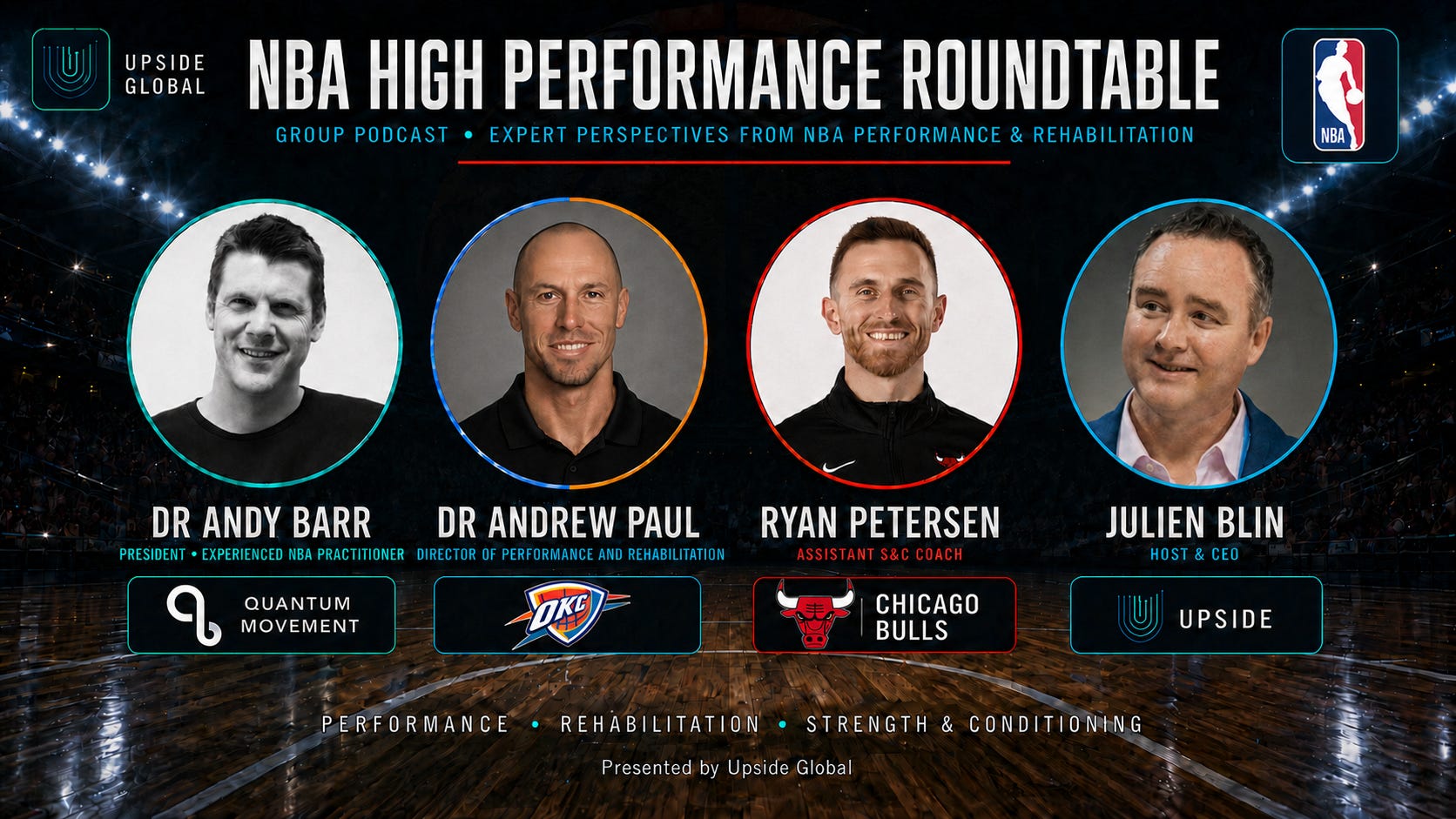
This week we have the honor to interview again a group of NBA sports performance executives to talk about the latest trends in the world of sports performance and rehabilitation.
Dr Andy Barr, president of Quantum Movement. Andy has worked in the NBA and professional soccer for 25 years for teams such as New York Knicks (NBA), NY Liberty (WNBA), the Brooklyn Nets (NBA), Manchester City (Premier League), Chelsea (Premier League), and NYFC (MLS).
Dr Andrew Paul, the Director of Performance and Rehabilitation for OKC (NBA).
Ryan Petersen, the assistant S&C coach for the Chicago Bulls (NBA).
Here are the topics that we covered during the video interview:
Q1. With training camp approaching, what should an ideal final few weeks of the offseason look like for an NBA player—physically, technically, and mentally?
Q2. Many players work with private coaches during the offseason. What does strong collaboration between a player’s private coach and NBA team staff look like, and where can problems arise?
Q3. What are the biggest offseason mistakes you see players make—such as overtraining, playing too much live basketball, chasing social-media workouts, or neglecting recovery?
Q4. How should offseason preparation be individualized based on a player’s age, injury history, role, expected minutes, and the way their team plans to use them?
Q5. When you look at players who consistently have successful, healthy seasons, what habits or decisions during the offseason separate them from everyone else?
Q6. If you could give every NBA player one piece of advice before training camp begins, what would it be?
You can watch the video interview below by clicking on the Youtube link. You can also listen to the audio interview by clicking on the link at the top of the page:
Here are some of the best quotes of our conversation with Andrew, Andy and Ryan:
Q1. With training camp approaching, what should an ideal final few weeks of the offseason look like for an NBA player—physically, technically and mentally?
Dr. Andy Barr
“The player has to go into camp fresh and prepared. They don’t want to be fatigued, but they need to be ready for the work they’re going to face and in the shape required to cope with the preseason.”
“Players often peak too soon in their offseason work. They need to be in shape to handle the demands, but they don’t want to peak too soon.”
“They might not be out of shape—they may have trained too much of the wrong things, or things that don’t align with the team’s philosophy.”
Dr. Andrew Paul
“Nowadays, I see players who are almost overprepared. They hit it so hard through August and September that they’re nearly overtrained when training camp begins.”
“If you’re even slightly mentally fatigued coming into October, then by January or February, you’re in a really tough spot.”
“One strategy I encourage is taking a vacation in late August or early September. It gives players a mental reset before the season.”
Ryan Petersen
“Showing up at your freshest—physically and mentally—is going to put you in a better position than cramming for the test for two or three weeks in August.”
“If you’re not excited to get back into the facility at the beginning of October, it’s going to be a long season.”
Recommendations for teams
Prioritize freshness over last-minute volume.
Gradually reduce the workload before camp.
Include basketball-specific conditioning.
Give players time to reset mentally.
Monitor rookies and players coming off long seasons.
Q2. What does strong collaboration between a player’s private coach and NBA team staff look like, and where can problems arise?
Dr. Andy Barr
“Ultimately, the player is going back into the team environment. You have the team philosophy, the coaches’ intentions, the strength and conditioning program and the medical requirements. You have to support that.”
“I would rather be an extension of the team than work in isolation and have my own agenda.”
“If you can embrace people and bring them in instead of creating barriers, you’re off to a good starting point.”
Dr. Andrew Paul
“We don’t want the player caught in the middle of anything. If they’re caught in the middle, it should be in the middle of positivity and support from both sides.”
“If I have an issue, I try to handle it without putting the player in the middle.”
“We’re not working against each other. We’re there to support one another, and at the end of the day, everyone’s agenda is pretty much the same.”
Ryan Petersen
“What has been effective for us is early and clear communication about our goals for the player’s offseason training, and then trusting the private coaches as professionals to implement their programs.”
“Regular check-ins allow you to address something sooner rather than having the player show up at the end of September with glaring holes in their preparation.”
“It’s all part of the cumulative offseason load. That needs to be laid out and understood by all parties.”
Recommendations for teams
Communicate with private coaches early.
Establish shared goals and workload expectations.
Include skill coaches in planning.
Schedule regular check-ins.
Resolve disagreements without involving the player.
Respect each professional’s expertise.
Q3. What are the biggest offseason mistakes players make?
Dr. Andrew Paul
“Offseason workouts have become heavily focused on individual, half-court, offensive skill work. Players may not get enough defensive work or full-court work.”
“It becomes one-dimensional loading for the tissues over and over again.”
“Players may miss defensive work, reactive lateral movement and full-court sprinting. That loading may not be totally representative of what the game actually is.”
Ryan Petersen
“The other issue is inconsistency in where players are and what they’re doing. They may be in Los Angeles for a week, Chicago for a week, back home and then on vacation.”
“There’s a structured plan, but they have six structured plans.”
“They’re not staying within one structure long enough to receive all the benefits it could offer.”
Dr. Andy Barr
“It’s not only multiple programs—it’s multiple locations and multiple time zones. Players are going to Europe, Asia, social-media events and appearances.”
“That contributes to psychological fatigue as well as physical fatigue, and it doesn’t allow them to be fresh.”
“Get a routine, get a rhythm, work on your deficits and then have a recovery period. Jet lag is a killer.”
Recommendations for teams
Track the player’s total workload.
Include full-court and defensive movement.
Avoid excessive one-dimensional training.
Encourage consistent training locations and routines.
Account for travel, sleep and mental fatigue.
Schedule meaningful recovery periods.
Q4. How should offseason preparation be individualized based on a player’s age, injury history, role, expected minutes and the way the team plans to use them?
Dr. Andy Barr
“It starts with an individualized plan that is communicated well with all the stakeholders.”
“Make sure the plan is appropriate for what the player needs, what their role is and their injury history.”
“Good communication, good planning, clear goals and alignment are the keys.”
Dr. Andrew Paul
“One of the most important people you need to communicate and align with on offseason goals is the player.”
“It starts with you and the player getting on the same page, so everyone knows what will be communicated, to whom and when.”
Ryan Petersen
“What is the plan for this player this season, but also three years from now?”
“Are we building this player to play meaningful minutes next year, or do we have a more gradual runway in which we want that player to become a contributor two or three years from now?”
“For a player at the end of a contract, the conversation becomes: What is most important to you for your career right now?”
Recommendations for teams
Build an individualized plan for every player.
Include the player in setting the goals.
Consider age, injuries, role and expected minutes.
Balance immediate readiness with long-term development.
Align team staff and outside providers.
Revisit the plan when circumstances change.
Q5. What habits or decisions separate players who consistently have successful, healthy seasons?
Dr. Andy Barr
Speaking about Kevin Durant’s offseason approach:
“He had his routine. He would stay in one place for four or five weeks and develop a really good rhythm.”
“There was always an intention behind what he did. He focused on mastering his craft, understanding his fundamentals and identifying what he needed to improve.”
“As he has become an aging athlete, he has focused more on his body—more quality and less quantity.”
Dr. Andrew Paul
“The best players usually plant themselves in one place and establish their routine.”
“They’re responsive when you reach out, and they proactively reach out when they need something.”
“They are masters at setting up their own environment for success and understanding how everyone fits into it.”
Ryan Petersen
“The veterans who truly understand their routines have been active participants in developing those habits.”
“They’ve taken pieces from different experiences and put them together into something truly tailored to them, by them.”
“They aren’t passively following instructions. They ask good questions, seek help and problem-solve for themselves.”
Recommendations for teams
Help players establish repeatable routines.
Favor quality and purpose over quantity.
Encourage players to ask questions.
Develop proactive communication habits.
Make athletes active participants in their preparation.
Adapt routines as players age and their roles change.
Q6. If you could give every NBA player one piece of advice before training camp begins, what would it be?
Dr. Andy Barr
“Be consistent. Plant yourself somewhere and stay consistent.”
Dr. Andrew Paul
“Don’t get too high and don’t get too low. Just keep showing up.”
“Whatever your biggest problem is today, two weeks from now you may forget it ever happened.”
Ryan Petersen
“This is such a privilege for all of us. Take a second to reflect on that.”
“It only takes 30 seconds to take stock of where you are, be grateful for the opportunity and find a little more motivation and energy to attack what you’re facing.”
Recommendations for teams
Keep the message simple.
Reinforce consistency over last-minute intensity.
Help players maintain emotional balance.
Encourage gratitude and perspective.
Focus on steady, daily progress.
You may also like:
🔥Upside NBA Video Chat with Dr Marco Nunez (Ex LA Lakers/NBA), Derek Millender (Cavs/NBA), Ryan Petersen (Chicago Bulls / NBA) on The Life after the NBA, Technology Adoption, Performance Optimization

This week we have the honor to interview again a group of NBA sports performance executives to talk about the latest trends in the world of sports performance and rehabilitation.
🔥Upside NBA Video Chat with Dr Marco Nunez (Ex LA Lakers/NBA), Derek Millender (Cavs/NBA), Dr Bill Burgos (Ex Timberwolves & LONU CEO) on Wearables, NBA Biomechanics Labs, Micro-Dosing Training

This week we have the honor to interview again a group of NBA sports performance executives to talk about the latest trends in the world of sports performance and rehabilitation.
🔥Upside Chat with Chris Chase (Memphis Grizzlies/NBA), Dr Marco Nunez (ex LA Lakers/NBA), Dr Andy Barr (Quantum Performance), Derek Millender (Cleveland Cavaliers /NBA).

This week we have the honor to interview again a group of NBA sports performance executives:


